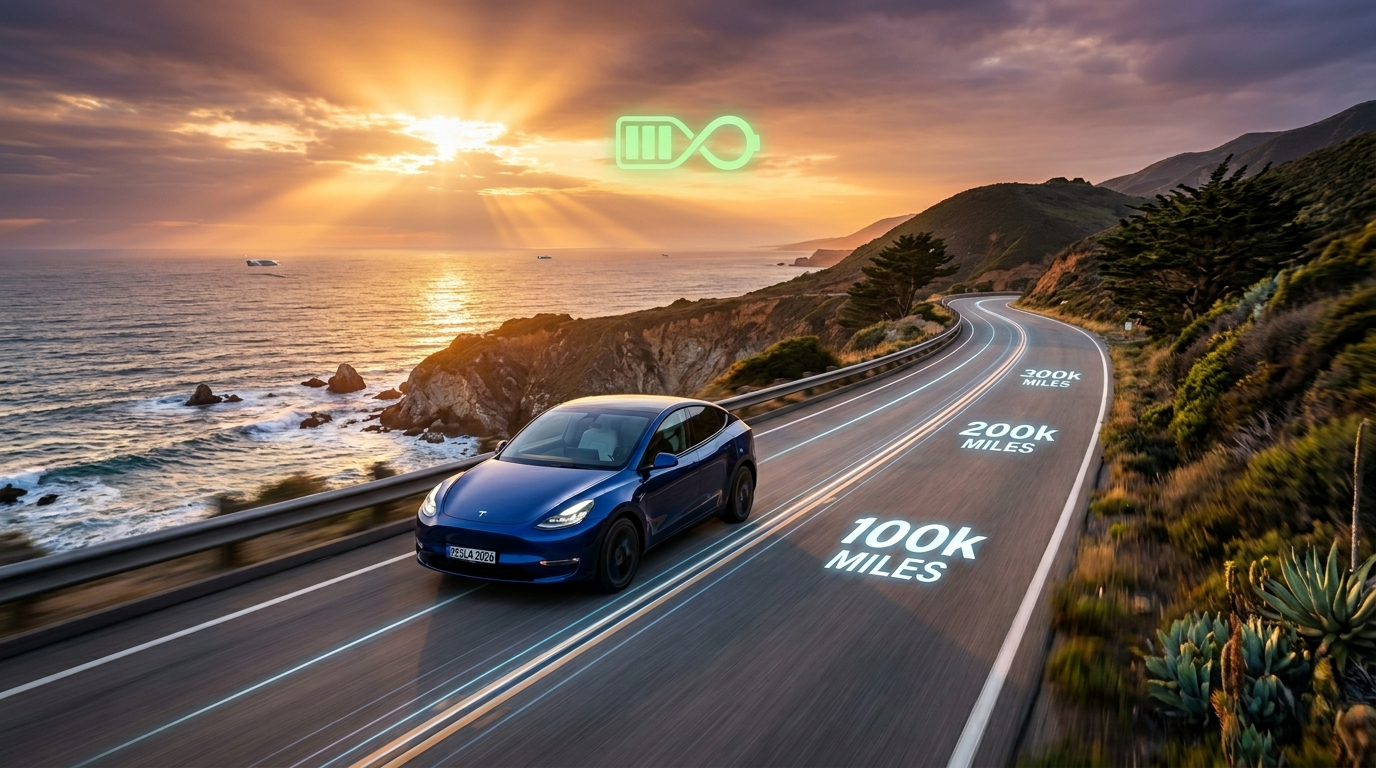
How Many Miles Does a Tesla Last?
Editor’s Note:
As the electric vehicle market matures, “range anxiety” is being replaced by “longevity anxiety.” This guide was developed to move past the myths and look at the hard data involving battery cycle life and hardware depreciation. Our editorial team has cross-referenced Tesla’s latest Impact Reports with real-world fleet data to ensure these mileage projections reflect the most current 2026 standards, especially regarding the long-term performance of LFP chemistry and the transition to Hardware 4.
Tesla vehicles are engineered to last far longer than most people think. With the right battery chemistry, a well-maintained Tesla can comfortably surpass 300,000 miles and in some cases, push past 500,000. Whether you are buying new or considering a used model, understanding what truly determines a Tesla’s lifespan will save you money and give you confidence on the road.
How Many Miles Does a Tesla Last?
| QUICK ANSWER |
| A Tesla can realistically last 300,000 to 500,000+ miles depending on the battery chemistry. Battery: LFP cells (newer Model 3/Y RWD) rated for 500,000+ miles. NMC cells ~200,000-300,000 miles. Motor: Drive units engineered for 1,000,000 miles far beyond any ICE transmission. Watch out for: Suspension wear at 100k-120k miles, software obsolescence (HW3 vs HW4), tire replacement every 25k-35k miles. Used Tesla verdict: Yes, worth it check battery health (90%+), hardware version, and suspension before buy in. |
Battery Lifespan: The 300,000-Mile Standar

Tesla batteries are built to last but not all cells are equal. Newer Model 3 and Model Y RWD variants use LFP (Lithium Iron Phosphate) chemistry, which offers a dramatically longer cycle life than the older NMC (Nickel Manganese Cobalt) cells found in earlier models.
A “charge cycle” is one full 0-100% charge. LFP batteries are rated for 3,000-4,000+ cycles before significant degradation compared to roughly 1,500-2,000 cycles for NMC. At 50 miles per charge, that’s potentially 500,000 miles of battery life for LFP owners.
| Feature | LFP (Newer RWD) | NMC (Older Models) |
|---|---|---|
| Cycle Life | 3,000-4,000+ cycles | 1,500-2,000 cycles |
| Potential Mileage | ~500,000 miles | ~200,000-300,000 miles |
| Range Impact | Slightly lower range | Higher range per charge |
| Daily Charge to 100% | Fine (recommended) | Limit to 80-90% |
| Cost | Lower | Higher |
Beyond the Battery: Drive Units & Motor

Tesla designs its drive units the electric motors powering the wheels with a target lifespan of 1,000,000 miles. Compare that to a traditional ICE (Internal Combustion Engine) transmission, which commonly needs major service by 150,000-200,000 miles.
Electric motors have roughly 20 moving parts vs. 200+ in a combustion drivetrain. Fewer parts means fewer failure points, less heat stress, and no oil changes. Tesla’s drive units have demonstrated remarkable real-world durability with many owners surpassing 300,000 miles on the original motor.
| Factor | Tesla Electric Motor | ICE Transmission |
|---|---|---|
| Moving parts | ~20 | 200+ |
| Expected lifespan | 1,000,000 miles (target) | 150,000-200,000 miles |
| Common failure points | Bearings (rare) | Clutch, seals, gears |
| Fluid changes needed | None | Every 30,000-60,000 miles |
Hardware & Software Obsolescence

Tesla is a “computer on wheels” meaning your car’s digital lifespan matters as much as its mechanical one. The key divide is between Hardware 3 (HW3), found in cars from 2019-2023, and Hardware 4 (HW4), introduced in late 2023.
A 2018 Tesla will still drive perfectly in 2030 but it may stop receiving Full Self-Driving (FSD) updates or new AI-powered features before its battery needs replacing. This is “software obsolescence”: the car works, but the tech falls behind. Always check hardware generation before buying used.
| Important: Software end-of-life may arrive before mechanical end-of-life. Always check the Hardware version before buying a used Tesla. |
| Spec | HW3 | HW4 |
|---|---|---|
| In vehicles from | 2019-2023 | Late 2023-present |
| FSD capability | Current FSD (limited) | Full FSD v12+ capable |
| OTA update outlook | Likely limited post-2027 | Supported through 2030+ |
| AI compute | 144 TOPS | ~1,000 TOPS (est.) |
Maintenance Milestones: What Breaks & When?
Maintenance Milestones: What Breaks & When?

Tesla is nearly maintenance-free compared to gas cars no oil changes, no spark plugs, no timing belt. But there’s one underrated factor: weight. A Model Y weighs ~4,400 lbs. That extra mass accelerates wear on suspension components and tires faster than a comparable gas vehicle.
Expect these non-battery costs as your Tesla ages:
- Tires: Replace every 25,000-35,000 miles. Cost: $600-$1,200 per set
- Front control arms/bushings: Wear at 80,000-120,000 miles. Cost: $400-$900 per side
- Rear control arm bushings: Similar timeline. Cost: $300-$700 per axle
- Brake fluid flush: Every 2 years or ~25,000 miles. Cost: $100-$200
- Cabin air filter: Every 2 years. Cost: $50-$80 (DIY-friendly)
- 12V battery replacement: Every 4-7 years. Cost: $100-$300
| Component | Typical Failure Mileage | Est. US Cost (out-of-warranty) |
|---|---|---|
| Tires (set of 4) | 25,000-35,000 miles | $600-$1,200 |
| Front control arms | 80,000-120,000 miles | $400-$900 per side |
| Rear bushings | 80,000-120,000 miles | $300-$700 per axle |
| Brake fluid flush | Every 2 years | $100-$200 |
| 12V battery | 4-7 years | $100-$300 |
Real-World Data: High-Mileage Tesla Case Studies

The numbers don’t lie. According to Tesla’s 2023 Impact Report, the average Tesla battery loses only about 12% of its capacity after 200,000 miles. That means an original 300-mile range car still delivers ~264 miles more than enough for most US daily driving. Real-world proof: Hans jorg von Gemmingen- Horn berg drove his Model S past 1,000,000 miles on a single car, with the original motor replaced only once. In the US, the “200k Mile Club” on Tesla forums documents hundreds of owners hitting 200,000+ miles with minimal degradation.
| Mileage Milestone | Avg Battery Capacity | Notes |
|---|---|---|
| 50,000 miles | ~97-98% | Negligible early degradation |
| 100,000 miles | ~93-95% | Most degradation already stabilized |
| 150,000 miles | ~90-92% | Still exceeds EPA range minimums |
| 200,000 miles | ~88-90% | Tesla fleet average per Impact Report |
| 300,000 miles | ~85%+ | LFP owners showing best retention |
Sustainability: What Happens After 500k Miles?

When a Tesla reaches the end of its road life, the battery doesn’t go to a landfill. Tesla operates a closed-loop recycling program: retired battery packs are first evaluated for a “second life” as stationary energy storage, then broken down to recover lithium, nickel, cobalt, and other materials for new battery production. Tesla reports their recycling process recovers over 92% of battery materials making end-of-life impact significantly lower than traditional vehicles. Choosing a Tesla is an environmentally responsible decision from purchase to retirement.
| Eco Note: Tesla’s closed-loop recycling recovers 92%+ of battery materials, supporting a genuinely circular energy economy. |
Verdict: Is a High-Mileage Used Tesla Worth It?
Yes with the right due diligence. A well-maintained Tesla with 100,000-150,000 miles can still offer 10+ years of reliable service. Here’s your pre-purchase checklist:
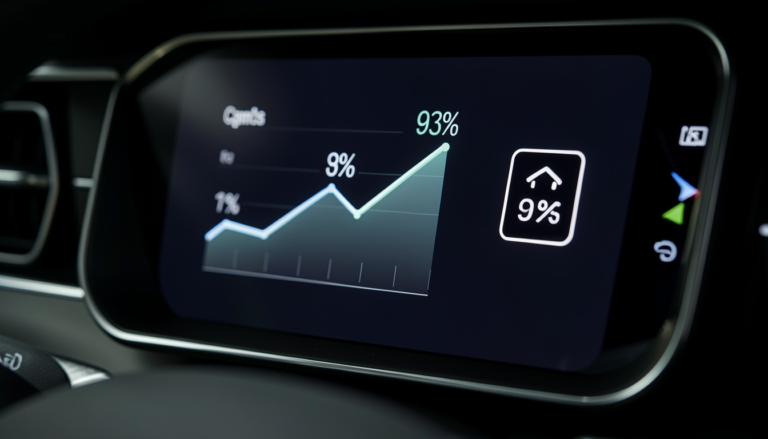
- Battery health: Access Service Mode (hold brake + tap Tesla logo 5x) look for 90%+ capacity
- Hardware version: Settings > Software > Additional Vehicle Info confirm HW3 or HW4
- Suspension: Test drive over speed bumps; listen for clunking from control arms
- Tire wear: Check tread depth and look for uneven patterns (sign of alignment issues)
- Accident history: Run a Carfax or AutoCheck report; avoid any frame damage
- Service records: Any drive unit replacements on record (rare, but worth noting)
| Bottom line: A Tesla is one of the only cars where 150,000 miles on the odometer should not scare you. With a verified battery health check and clean suspension, a high-mileage Tesla often outlasts — and outperforms — a low-mileage gas car of the same age. |
| Check Item | How to Verify | Green Flag | Red Flag |
|---|---|---|---|
| Battery health | Service Mode menu | 92%+ remaining | Below 80% |
| Hardware version | Settings > About | HW3 or HW4 | HW2.5 or older |
| Suspension feel | Test drive over bumps | Quiet and firm | Clunking or pulling |
| Tire wear | Visual + tread gauge | Even, >4/32″ tread | Uneven or cupping |
| Accident history | Carfax / AutoCheck | Clean title | Frame/structural damage |
Latest Updates
To keep this resource relevant, we track ongoing changes in Tesla’s hardware and software ecosystem. Here is what has changed recently:
- May 2026 Update: New fleet data from early 2021 Model 3 LFP units shows that battery degradation has plateaued at ~5% for many users, even with consistent 100% daily charging.
- January 2026 Update: Tesla has expanded its “out-of-warranty” battery remanufacturing program, significantly lowering the cost of pack replacements for older Model S and Model X vehicles.
- Late 2025 Update: With the wider rollout of FSD v12.5 and v13, the performance gap between HW3 and HW4 has become more defined. We have updated our “Software Obsolescence” section to reflect the long-term support outlook for older processors.
- Maintenance Note: Updated estimated costs for suspension components to reflect current 2026 service center labor rates and the availability of third-party heavy-duty control arms.
Author’s Note
I’ve spent countless hours diving into technical teardowns and battery health spreadsheets because I believe transparency is the key to EV adoption. Most people view a car with 100,000 miles as “nearing the end,” but in the EV world—and specifically within the Tesla ecosystem that’s often just the break-in period. My goal with this article is to give you a technical yet practical framework to evaluate a Tesla’s true lifespan, whether you’re looking at a brand-new Model Y “Juniper” or a veteran Model 3.