Worth the Watt: A Complete History of the Electric Car
Editor’s Note: While often viewed as a recent Silicon Valley invention, the electric vehicle actually spans two centuries of innovation. This guide provides the critical historical context needed to make informed decisions in today’s market. Updated June 2026 to reflect current industry standards.
Most people assume electric cars are a recent invention a product of Silicon Valley ambition and climate anxiety. The truth is far more surprising. EVs have existed for nearly 200 years, once dominated American roads, and were nearly forgotten before Tesla brought them back into the spotlight. Here’s what you need to know. Worth the Watt
| Quick Answer The electric car’s origins don’t actually start with Tesla.. EVs date back to the 1830s, and they outsold gas cars in the US around 1900. Tesla’s real achievement was making EVs desirable with long range, fast charging, and software updates which forced every major automaker to follow. |
Key Takeaways
| Electric cars predate gasoline vehicles the first prototypes date to the 1830s.EVs outsold gas cars in the US around 1900 women were among their biggest fans.Tesla did not invent the EV but it made millions of Americans want one.Understanding EV history helps you make smarter decisions when buying used today. |
Early Sparks: 1830s to 1890s
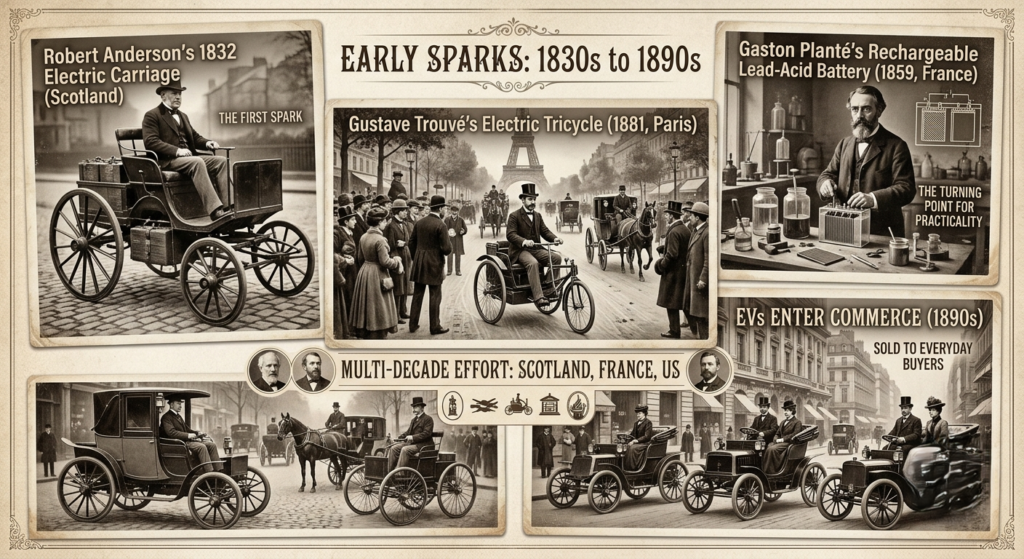
Electric vehicles predate Silicon Valley by nearly two centuries. Robert Anderson built a basic electric carriage in 1832, and by the 1880s French engineers were selling battery-powered road vehicles. Gaston Planté’s 1859 rechargeable lead-acid battery was the turning point it made EVs practical, not just possible.
- Robert Anderson’s 1832 carriage predates the gasoline engine electric came first.
- Gustave Trouvé demonstrated a working electric tricycle on Paris streets in 1881, attracting public crowds.
- No single inventor “created” the EV it was a multi-decade effort across Scotland, France, and the US.
- By the 1890s, electric cars were commercial products not experiments sold to everyday buyers.
The First EV Boom: 1890 to 1920

Around 1900, electric vehicles outsold gasoline cars in the US. They were quiet, clean, and easy to start a stark contrast to gas cars that required dangerous hand-cranking. Women, doctors, and city dwellers preferred them. By 1912, over 30,000 EVs were registered across the country.
- The 1894 Electrobat was one of the first commercially viable US electric vehicles, built in Philadelphia.
- New York City launched the world’s first electric taxi fleet in 1897 decades before Uber.
- Thomas Edison himself tried to build a better EV battery in the early 1900s a sign of how seriously EVs were taken.
| 30,000+EVs on US roads (1912) | ~20 mphTop speed (early EVs) | New YorkFirst EV taxi city (1897) |
The Long Winter: 1920s to 1990s

Cheap gasoline, Ford’s affordable Model T, and expanding rural roads killed the EV market almost overnight. For 70 years, electric cars retreated to golf carts and forklifts. The 1970s oil crisis revived brief interest, but weak batteries and poor infrastructure kept EVs on the fringe.
- GM’s EV1 (1996) was fast, efficient, and beloved then recalled and crushed by 2003 in a decision still debated today.
- The 1973 oil embargo pushed several US automakers to study EV alternatives but none reached mass production.
- California’s 1990 Zero Emission Vehicle mandate forced automakers to take EVs seriously again, paving the way for the modern era.
Tesla’s Real Firsts
Tesla didn’t invent the EV it reinvented the desire for one. The 2008 Roadster proved EVs could be thrilling. The 2012 Model S delivered 200+ miles of range, a giant touchscreen, and over-the-air updates. No other automaker was doing any of that. The Supercharger network solved range anxiety for good.
- Tesla’s direct sales model cut out dealerships a first for any major US automaker, electric or otherwise.
- Over-the-air software updates meant Tesla owners got a better car over time without visiting a service center.
- The Supercharger network now 50,000+ stations globally remains the largest fast-charging infrastructure in the world.
Tesla Milestones
| Year | Model | Significance |
| 2008 | Roadster | First highway speed EV with 200+ mile real-world range |
| 2012 | Model S | Over-the-air updates; Supercharger network launched |
| 2017 | Model 3 | Mass-market EV Tesla’s best-selling vehicle |
| 2024 | Industry shift | Every major automaker launches competing EV lines |
What This Means When You Buy Used
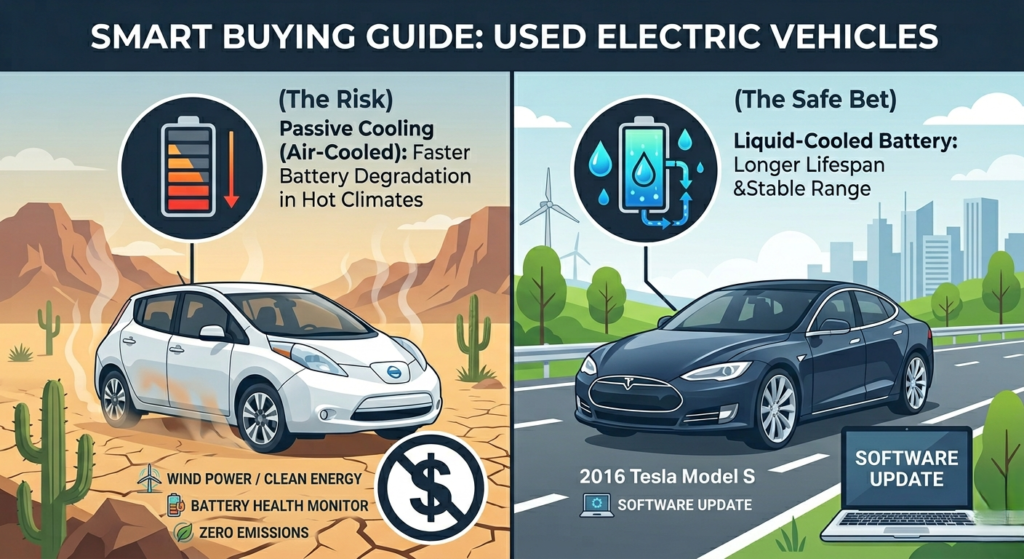
EV history matters when you shop today. Early Nissan Leafs (2011–2015) used passive cooling and degrade faster in hot climates. A used Model S from 2015+ still software updates and has a solid battery track record. Knowing the lineage helps you avoid costly mistakes.
- Tesla’s no-dealership model means used prices are more transparent but also less negotiable than traditional used cars.
- Check battery thermal management before buying any used EV passive cooling degrades far faster in warm US states.
- The Supercharger network still gives Tesla used buyers a practical edge over most competitors for long-distance travel.
| Bottom Line: The electric car is nearly 200 years old. Tesla didn’t invent it but Tesla made millions of Americans want one. That distinction is everything. |
Latest Updates:
- The NACS Standard is Universal: As of mid-2026, the shift to the North American Charging Standard (NACS) is effectively complete for all major automakers. When shopping for a used EV, prioritizing a vehicle with native NACS access or one that will receive a reliable adapter—is more important than ever for resale value.
- The “Juniper” Effect: With the release of the refreshed Model Y (Project Juniper), we are seeing the market react to updated suspension and interior aesthetics. For buyers, this creates a unique opportunity: early-generation Model Ys are seeing price adjustments, making them some of the best-value used vehicles on the market today.
- Battery Tech Maturity: We are currently tracking long-term data on the latest structural battery packs. Unlike the early degradation observed in the 2011–2015 Nissan Leaf era, modern 2026 thermal management systems are proving to be significantly more resilient, reinforcing the importance of checking your software version before buying used.
Author Note: I’ve spent years analyzing the technical evolution of the Tesla ecosystem from early battery chemistry shifts to the recent advancements in FSD and hardware. Throughout my research for this piece, I found that the most common mistake buyers make today is ignoring the lineage of the vehicles they are purchasing. Whether you are looking into a legacy EV or a modern refresh, knowing what technology is under the hood is your best defense against bad investments. If you have questions about specific model years or battery health, feel free to drop a comment below.