Tesla Seat Belt Safety Features Deep Dive
| Quick Answer: Tesla seat belt safety features use a camera-based neural network that detects a crash milliseconds before impact and pre-tightens the belt before the collision hits. Combined with double-stage pretensioners, load limiters, and occupant detection, Tesla’s restraint system is one of the most advanced in any production car today. Tesla Seat Belt Safety Features Deep Dive |
Tesla has completely rethought how seat belts protect you in a crash. Their system does not just react it predicts. Here is a full breakdown of every Tesla seat belt safety feature and why it makes a real difference.
1. How Tesla Vision Activates Seat Belts Before a Crash

Most cars tighten seat belts only after a crash sensor feels the impact. By then, your body is already moving forward inside the cabin.Tesla Vision uses eight cameras and a neural network that reads the environment in real time. When it detects a collision is unavoidable, it fires the pre-tension signal before the physical impact arrives.The belt is already snug against your body when crash forces hit. Your pelvis and chest stay in position instead of lurching forward first.
2. Double-Stage Pretensioners: What They Are and How They Work

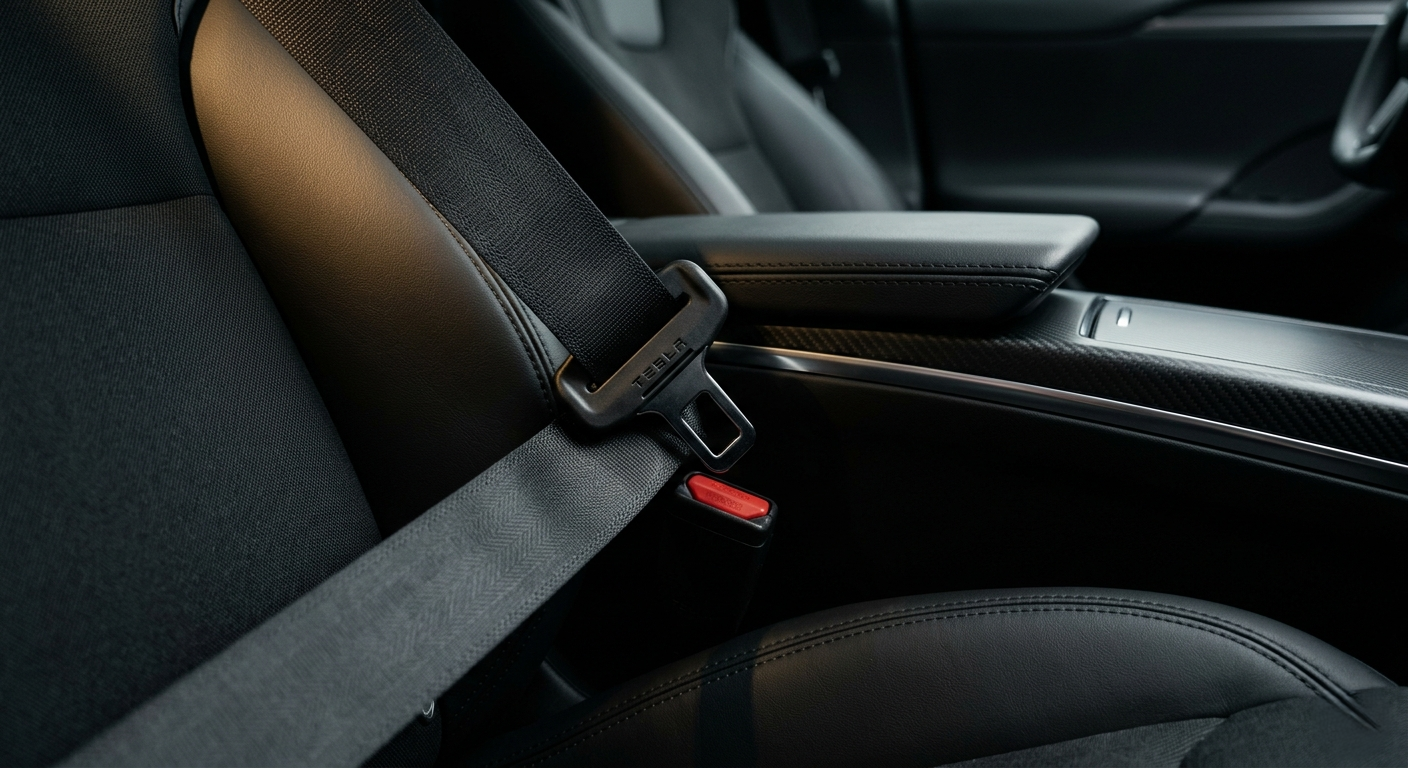
Tesla front seats use double-stage pretensioners small pyrotechnic devices attached at two points on the belt. When the signal fires, both stages activate at once. The lower anchor pulls the lap section tight across your pelvis while the upper stage pulls the shoulder webbing across your chest. This dual-point system prevents submarining where the pelvis slides forward under the lap belt during a crash. It is one of the most important Tesla seat belt safety features in the entire restraint system.
3. Load Limiters: Protecting Your Ribcage After Impact

A belt that is too tight for too long causes its own injuries. Load limiters solve this problem.Right after peak crash force, the load limiter releases a small controlled amount of webbing. This drops chest pressure before it reaches a dangerous level.Every Tesla seat has a calibrated load limiter tuned per seat position based on expected occupant size and crash dynamics.
4. Occupant Detection and Airbag Coordination

Pressure sensors inside each seat classify the occupant as an adult, child, or rear-facing child seat. This data goes directly to the airbag control module.The airbag adjusts deployment force and timing based on who is sitting there. The seat belt pretension signal and airbag signal fire together in coordination.This synchronized response is a core reason Tesla scores at the top in crash tests. The belt and airbag work as one matched system, not two separate ones.
5.5. Tesla Seat Belt Safety Features Deep Dive: Tesla vs. Traditional Cars

| Feature | Traditional Cars | Tesla |
|---|---|---|
| Pretensioner Trigger | Crash sensor (reactive) | Camera + AI (predictive) |
| Belt Points Tensioned | One (shoulder only) | Two (shoulder + lap anchor) |
| Load Limiter | Some models only | All models, seat-calibrated |
| Rear Seat Pretensioners | Rare | Standard on outboard seats |
| OTA Updates | Not possible | Yes, updated remotely |
| Occupant Classification | Basic weight sensor | Full sync with airbag system |
The biggest gap is in the triggering method and rear-seat coverage. Both of these directly affect real-world survivability in serious crashes.
6. Rear Seat Pretensioners: Protection for the Whole Cabin

Most carmakers fit pretensioners only to front seats. Tesla includes them on rear outboard seats across the full lineup.Every rear seating position in the Model S and Model X is equipped with a three-point seatbelt featuring integrated pretensioners. Model 3 and Model Y cover the two rear outboard seats.Children and elderly passengers sit in the rear most often. These Tesla seat belt safety features make sure the whole cabin is protected, not just the front row.
7. Seat Belt Coverage Across the Tesla Lineup

| Model | Front Pretensioners | Rear Pretensioners | OTA Calibration |
|---|---|---|---|
| Model 3 | Double-stage | Outboard seats | Yes |
| Model Y | Double-stage | Outboard seats | Yes |
| Model S | Double-stage | All 3 positions | Yes |
| Model X | Double-stage | All 3 positions | Yes |
| Cybertruck | Double-stage | All positions | Yes |
Cybertruck has the most complete rear coverage in the lineup. Every model gets OTA calibration, which means the system improves over time without any dealer visit.
8. Inertia Reel Lock Up During Hard Braking

Every Tesla seat belt uses a vehicle-sensitive inertia reel. Under normal driving the belt moves freely. During hard braking or sharp cornering, the reel locks instantly.This keeps you in your seat before the pretensioner fires. During FSD and Autopilot emergency inputs, the reel locks in the same fraction of a second as the vehicle maneuver.Tesla’s active safety systems work together at all times. For a full overview of how each system connects, the top Tesla features guide on RevTesla covers everything in one place.
9. OTA Updates: Continuous Improvements to Tesla’s Seat Belt Safety

Tesla pushes over-the-air updates that directly affect restraint system behavior. Updates have refined Tesla Vision crash detection thresholds, tuned occupant classification sensitivity, and adjusted airbag-to-belt timing. Your seat belt system today may behave differently from the day you bought the car usually better. No dealer visit needed. Some owners notice phantom belt tensioning events reduce after certain updates. Tesla calibrates these thresholds continuously as Tesla Vision collects more real-world data.
10. Seat Belt Behavior During Autopilot and FSD

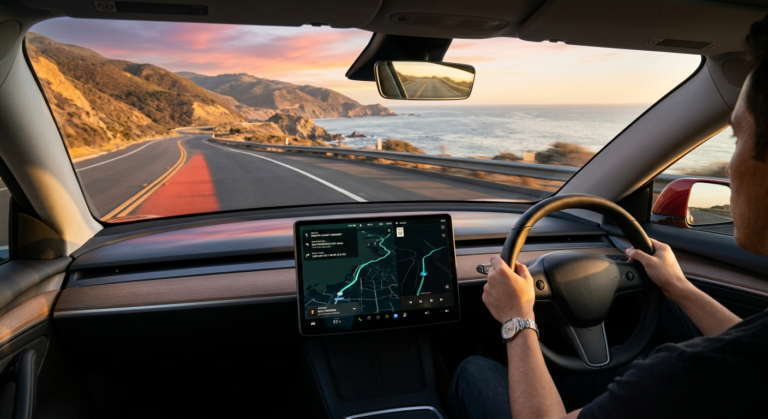
During Autopilot and Full Self-Driving, Tesla Vision monitors the road constantly. If the system detects an emergency, it brakes, steers, and pre-tensions the belts at the same time. Drivers sometimes feel the belt tighten with no visible hazard. This is the neural network flagging a risk that was resolved before a crash happened the system functioning correctly. Tesla also uses route data during highway driving to prepare for upcoming decisions. If you use Autopilot on long trips, the Tesla navigation optimization guide on RevTesla explains how to set up the routing system properly.
11. Child Safety and Tesla Seat Belt System

Tesla’s classification system detects a rear-facing child seat and automatically suppresses the front passenger airbag. This is a legal safety requirement and Tesla handles it automatically.The rear outboard pretensioner still fires in a crash regardless of child or adult occupancy. A forward facing child in a car seat gets full belt restraint even if no airbag deploys .LATCH anchors in all Tesla models are reinforced and tested to the same crash standards as the belt system itself. Always use an approved child seat with the LATCH points.
12. Seat Belt Height Adjustment and Fit
All Tesla front seats include a B-pillar height adjuster for the shoulder belt. This lets you position the belt across your chest correctly based on your height.A belt that sits too high rubs against the neck. Too low and it crosses the arm instead of the chest. Both positions reduce the effectiveness of the pretensioner during a crash.Tesla recommends adjusting the height before every drive if the seat position changes. The setting is mechanical, not software-controlled, and does not reset after an OTA update.
13. Seat Belt Reminder System and Driver Monitoring

Tesla’s touchscreen displays a real-time buckle status for every seat. You can see at a glance which passengers are belted and which are not before you start driving. The system uses both the buckle sensor and the seat weight sensor together. An unbuckled passenger combined with detected seat weight triggers both a chime and a screen alert. Driver Monitoring through the cabin camera also checks whether the driver is wearing a seat belt. If the belt is not buckled during certain driving modes, features like Navigate on Autopilot will not activate.
14. What Happens to the Seat Belt After a Crash

After any significant crash where the pretensioner fires, the seat belt must be replaced. The pyrotechnic charge is single-use. Once fired, the pretensioner cannot reset. Tesla service centers inspect the full restraint system after an airbag deployment. This includes the belt webbing, retractor, pretensioner, and load limiter all components are checked and replaced as needed. Driving with a previously fired pretensioner puts every passenger at serious risk. Even if the belt looks fine, the pretensioner will not activate again in a second crash.
15. Common Seat Belt Issues Tesla Owners Report

Phantom Belt Tensioning on FSD
Belt tightens suddenly with no visible crash. Tesla Vision flagged a risk that was resolved before impact the system working as designed.Tesla has tuned this threshold through several OTA updates. It happens less often on newer software versions.
Rear Seat Chime With No Passenger
A bag, groceries, or a pet on the back seat triggers the buckle reminder. The weight sensor reads the load and fires the alert.Buckle the unused rear belt or dismiss the alert from the touchscreen. Tesla has adjusted the threshold in recent updates.
Belt Feels Stiff After Emergency Braking
If the inertia reel locks hard, the belt may feel stiff for a few seconds. This is normal — the reel resets once the car is stable again.
16. NHTSA and IIHS Safety Ratings
NHTSA gave Model Y and Model 3 five-star overall safety ratings across every test category. Both models hold the maximum score in frontal and side crash tests. IIHS named Model 3 and Model Y as Top Safety Pick+ its highest designation. The restraint system scored Good in small overlap frontal tests.
These results come from the full set of Tesla seat belt safety features working together pretensioners, load limiters, Tesla Vision pre-crash detection, and airbag coordination all firing as one system.
Final Thoughts
Tesla seat belt safety features go far beyond a standard three-point belt. Predictive pre-tensioning, dual-point pretensioners, load limiters, rear-seat coverage, height adjustment, post-crash protocols, and continuous OTA refinement make this a fundamentally different system If you are buying a Tesla for your family, the safety data backs it up and knowing how each feature works makes that data meaningful.