First Consumer Car in Space: Where Is the Cherry Red Tesla Roadster Now?
| Quick AnswerThe first consumer car in space, a cherry red Tesla, is still drifting around the Sun since its 2018 launch. In 2026, it remains millions of miles from Earth, its paint likely bleached by radiation, with no real chance of hitting our planet anytime soon. |
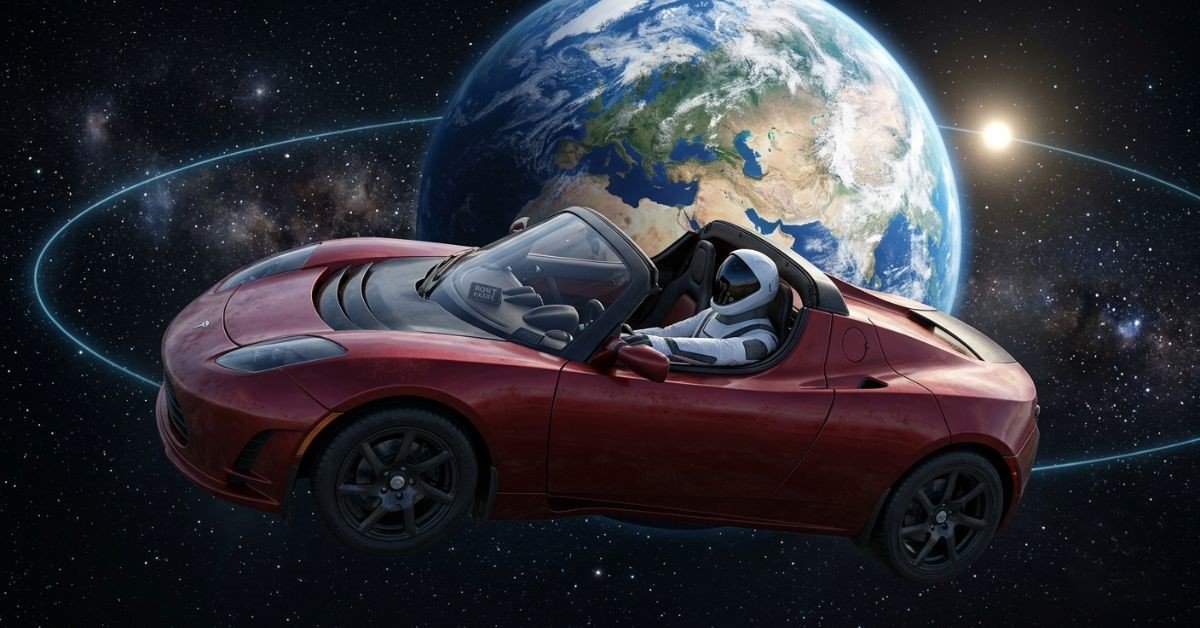
On February 6, 2018, SpaceX strapped the personal Roadster belonging to Elon Musk the man who still owns and leads Tesla today to the top of a Falcon Heavy rocket and launched it into deep space. This was the same original Roadster model built back when Tesla first started selling cars, and it became the first consumer car in space, a cherry red Tesla with a mannequin named Starman at the wheel. Years later, people still search daily for where this car is right now and what it looks like today.
Quick Orbital Snapshot: The Space Tesla by the Numbers
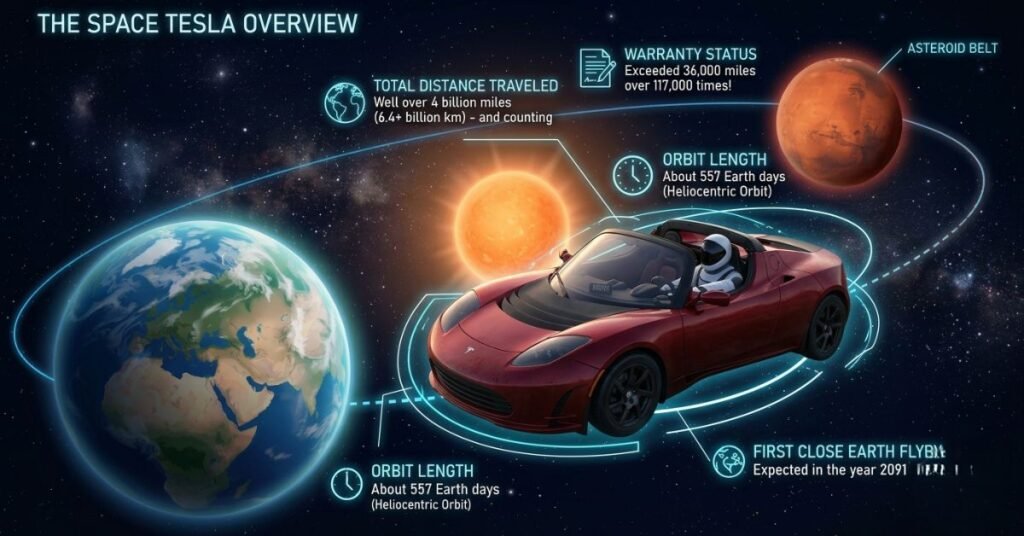
Before diving in, here is a quick overview of the cherry red Tesla Roadster the world’s first commercial car launched into outer space, which continues to orbit the Sun.
| Metric | Current Status |
| Total distance traveled | Well over 4 billion miles since launch |
| Warranty status | Exceeded its 36,000-mile warranty over 117,000 times |
| Orbit length | About 557 Earth days around the Sun |
| Orbit path | Loops between Earth’s orbit and the asteroid belt beyond Mars |
| First close Earth flyby | Expected in the year 2091 |
What Is the Current Location of Elon Musk’s Tesla Roadster?
The first consumer car in space, a cherry red Tesla, does not sit still. It follows its own path around the Sun, drifting between Earth’s orbit and a point beyond Mars, so its distance from us keeps changing.This space Tesla is not a fixed dot on a map. It is genuinely orbiting the Sun on its own schedule, just like a tiny planet made of metal, glass, and cherry red paint.
The 2025 Asteroid Misidentification (Object 2018 CN41)
On January 2, 2025, the Minor Planet Center logged what looked like a brand-new near-Earth asteroid, naming it 2018 CN41. A citizen astronomer in Turkey had spotted it using public tracking data.
Less than a day later, the discovery was quietly deleted. Experts realized the orbit matched an artificial object: the Falcon Heavy upper stage carrying the first consumer car in space, a cherry red Tesla still cruising the solar system.
It was not the first mix-up of its kind. NASA’s WMAP satellite and the Rosetta spacecraft have both been briefly mistaken for asteroids in the past, showing just how hard it is to track small, man-made objects once they leave Earth.
Heliocentric Orbit & Distance From Earth
The first consumer car in space, a cherry red Tesla, circles the Sun roughly once every 557 days on an elongated path. At its closest, that path brushes near Earth’s orbit; at its farthest, it swings out past Mars toward the asteroid belt.
Because the orbit is constantly shifting, the exact distance from Earth changes every single day. Live trackers such as whereisroadster.com use NASA’s JPL Horizons data to calculate this in real time.
What Does the Cherry Red Tesla Look Like Today? (Space Degradation)
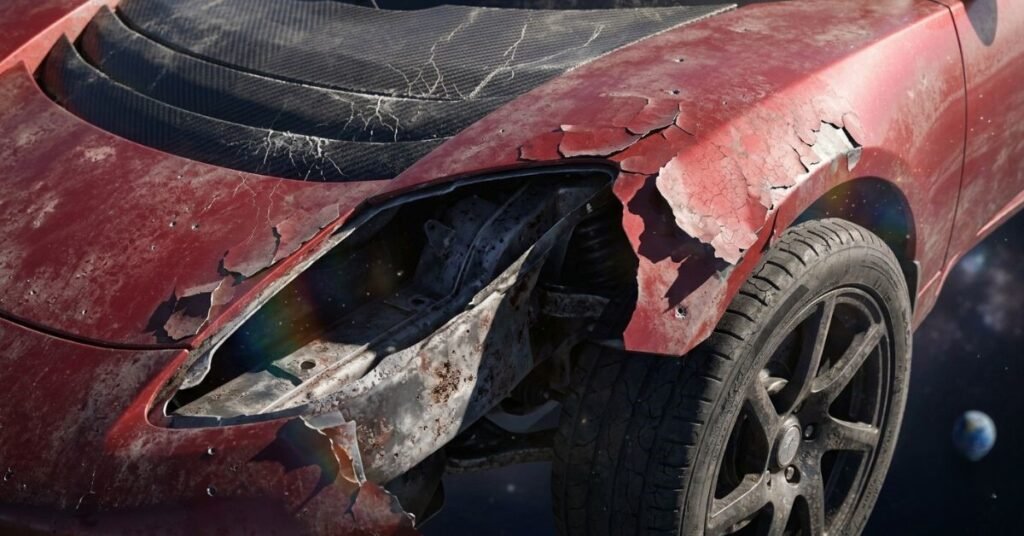
Space has not been kind to the first consumer car in space, a cherry red Tesla built for city streets, not solar radiation. Between constant sunlight, deep cold, and cosmic rays, the car has almost certainly changed a lot since 2018.
Here is a quick look at how different parts of the first consumer car in space, a cherry red Tesla, are expected to be holding up after years of exposure:
| Component | Expected Condition Today |
| Paint (cherry red) | Faded, bleached, likely cracked or peeling |
| Tires & rubber trim | Brittle, cracked, breaking down |
| Leather seats | Degraded, possibly disintegrating |
| Carbon fiber body | Slow to degrade, still mostly intact |
| Aluminum chassis | Expected to last hundreds of thousands of years |
Radiation Bleaching: Is It Still Red?
Scientists say unfiltered solar radiation breaks down the chemical bonds in automotive paint over time. Chemist William Carroll told reporters the car’s organic materials would not last long once exposed.
Many specialists suggest that the original glossy red paint has likely faded, cracked, and flaked off, transforming the bright Roadster into a weathered, discolored vehicle.
The Fate of Tires, Leather, and Carbon Fiber
The rubber tires and leather seats are built from organic compounds, exactly the kind of material that space radiation attacks first. Researchers expect these parts to be brittle, cracked, or partly disintegrated by now.
The carbon fiber body and the underlying aluminum chassis are tougher. Engineers believe the metal frame could realistically survive for hundreds of thousands of years, long after the paint and interior are gone.
5 Hidden Easter Eggs Aboard the Space Roadster
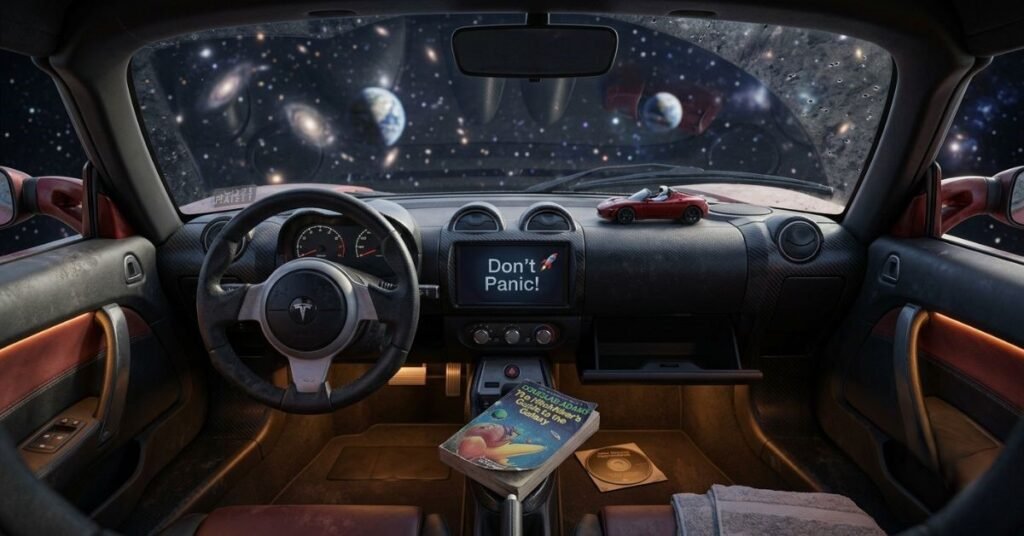
Beyond the car itself, SpaceX and Tesla packed the first consumer car in space, a cherry red Tesla, with small tributes and inside jokes before launch.
- Inside the vehicle, a circuit board carries the inscribed words ‘Made on Earth by Humans,’ accompanied by an engraved plate honoring the team behind the spaceflight. .
- The Hitchhiker’s Guide & Towel — a copy of Douglas Adams’ novel sits in the glove box, with a matching towel and a dashboard sign reading “Don’t Panic!”
- 5D Quartz Data Disc — a laser-etched optical disc from the Arch Mission Foundation carrying Isaac Asimov’s Foundation trilogy.
- Hot Wheels Miniature Roadster — a tiny die-cast version of the car, complete with its own mini Starman, mounted on the real dashboard.
- David Bowie on Loop — the car’s sound system was set to play “Space Oddity” and “Life on Mars?” on repeat during the journey.
Each detail adds to why the first consumer car in space, a cherry red Tesla, still fascinates people years after launch.
Will the Tesla Roadster Ever Crash Into Earth or Mars?
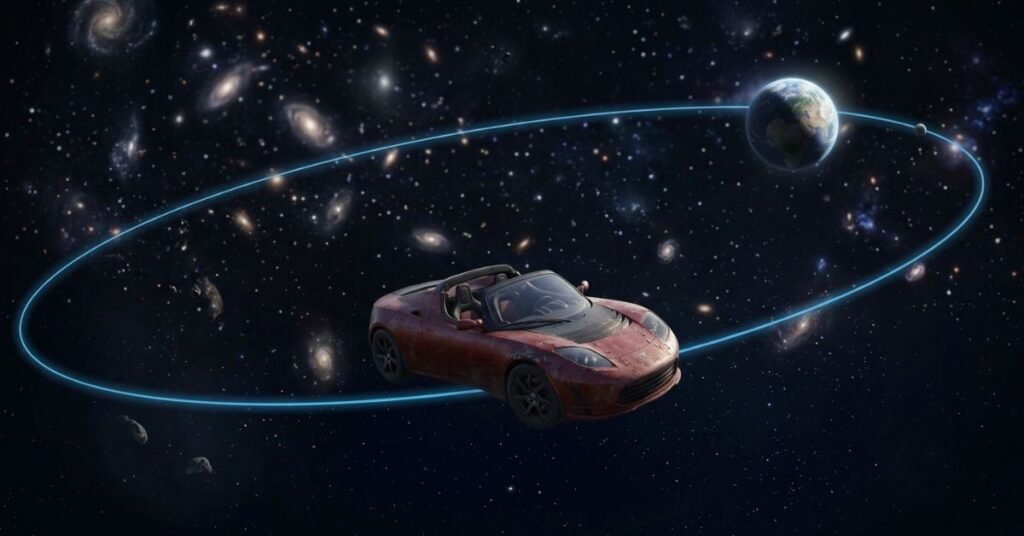
Short answer: almost certainly not anytime soon. Astronomers have run the numbers, and Earth is in no real danger from the first consumer car in space, a cherry red Tesla on a slow, drifting orbit.
Orbital Trajectory & Collision Probabilities
A widely cited study from the University of Toronto modeled the Roadster’s orbit over millions of years. It found roughly a 6 percent chance of hitting Earth, and a 2.5 percent chance of hitting Venus, within the next one million years.
Over a longer 15-million-year window, those odds rise to about 22 percent for Earth and 12 percent for Venus, but that is a timescale far beyond any human lifetime.
The Next Close Flyby (2091 and Beyond)
The same research points to the year 2091 as the Roadster’s first genuinely close pass by Earth, potentially closer than the Moon. Even then, an actual impact is not expected.
After that first flyby, the car’s path becomes harder to predict precisely, since each close pass with a planet nudges its orbit slightly. Scientists call this a slow, random walk through the inner solar system.
Frequently Asked Questions (FAQ)
Is Starman’s battery still working?
No. The onboard cameras and their batteries were only rated for about 12 hours and actually went dark after roughly 4 hours in space, cutting off the live video feed from the first consumer car in space, a cherry red Tesla, not long after launch — proving that even in deep space, a Tesla still has to prove it’s worth the watt.
How can I track the Tesla Roadster in real-time?
The website whereisroadster.com, built by developer Ben Pearson, pulls daily orbital data from NASA’s JPL Horizons system to show the live distance, speed, and position of the first consumer car in space, a cherry red Tesla.
Where is the car right now?
It is somewhere between Earth’s orbit and the asteroid belt beyond Mars, moving at tens of thousands of miles per hour. For the exact current distance, check a live tracker, since the number changes every day.
Could the Roadster ever be recovered?
Practically speaking, no. There is no mission planned to catch up with the first consumer car in space, a cherry red Tesla now far beyond the reach of any existing spacecraft.
Conclusion
Almost a decade on, the first consumer car in space, a cherry red Tesla, is still out there, faded, weathered, and drifting quietly around the Sun. It remains one of the strangest and most talked-about objects humans have ever sent beyond Earth.
Between the 2025 asteroid scare, the slow radiation damage, and a first close pass by Earth not due until 2091, this car’s story is far from over. For now, it just keeps circling, warranty long expired, waiting for its next close encounter.
If the original Roadster has you dreaming about Tesla’s newer sports cars, take a look at what Tesla sports cars are currently for sale back here on Earth.