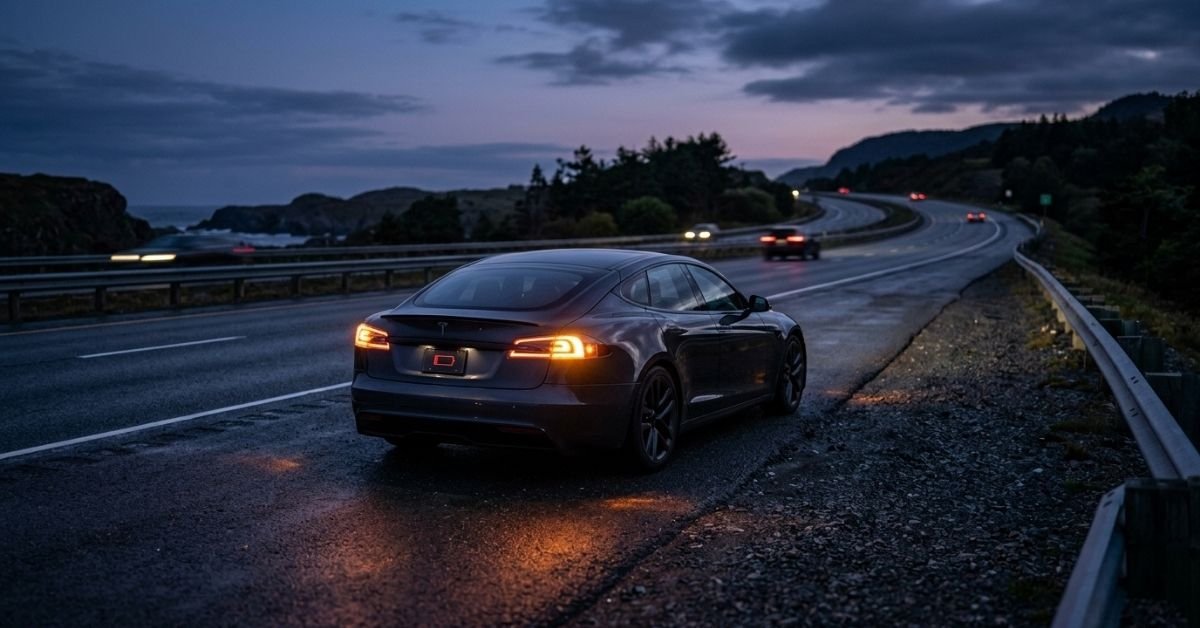
Tesla Battery 0 Percent: What Happens Next?
If your Tesla battery reaches 0%, the car does not simply keep driving with a hidden reserve. Tesla treats a displayed 0% or 0 miles as no usable range: the vehicle can lose power, stop, and eventually become unable to charge normally if its low-voltage battery is no longer supported. The safest response is to get off the road, connect to a suitable charger immediately, or arrange roadside assistance. Leaving the car at zero for an extended period can damage battery-related components, including the low-voltage battery.
Quick Answer: Tesla Battery 0 Percent What Happens?
When a Tesla reaches 0%, available driving energy is effectively exhausted. Power may be reduced first, warnings can appear, and the vehicle may shut down unexpectedly. Tesla says not to assume any range remains at 0%. If you are already stopped, plug the car in immediately. If you cannot reach a charger, stop somewhere safe and contact roadside assistance or a tow provider. Do not wait at 0% hoping the vehicle will recover.
What Happens Before a Tesla Reaches 0%?
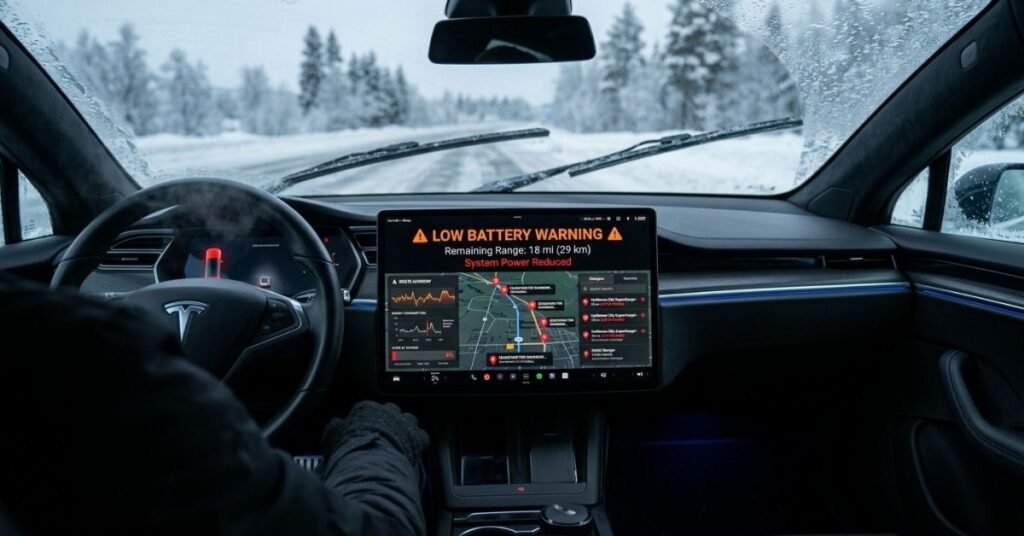
Tesla’s battery-management system continuously estimates remaining energy and displays warnings as the state of charge falls. The exact warnings and behavior can vary with model, software, temperature, battery condition, and driving conditions.
As the battery gets very low, you may notice reduced available power. Tesla manuals describe a low-battery power limitation, which can make acceleration weaker and reduce the vehicle’s ability to maintain normal performance. Regenerative braking can also be limited in certain low-energy or temperature conditions.
The displayed percentage is an estimate of usable energy, not a promise that the car will travel a specific number of miles. A Tesla showing a small percentage can still have enough energy to reach a nearby charger, while another vehicle under different conditions may reach its limit sooner.That is why navigation estimates and the remaining range should be treated as guidance rather than a guaranteed reserve.
Does 0% Mean the Battery Is Physically Empty?

Not necessarily. A displayed 0% does not mean every lithium-ion cell has literally reached absolute zero energy. Tesla’s battery-management system protects the high-voltage pack and limits operation before unsafe conditions are reached.
However, this distinction should never be interpreted as permission to keep driving. Tesla’s Model 3 manual specifically warns owners not to assume any range is available when the display reaches 0 miles or 0%.
The practical difference is important: there may be energy that the system cannot safely make available for propulsion, but that does not give the driver a dependable emergency buffer. Conditions can change quickly, especially with cold temperatures, high speed, hills, strong headwinds, heavy loads, or climate-control use.
What Happens When the Tesla Actually Runs Out of Range?
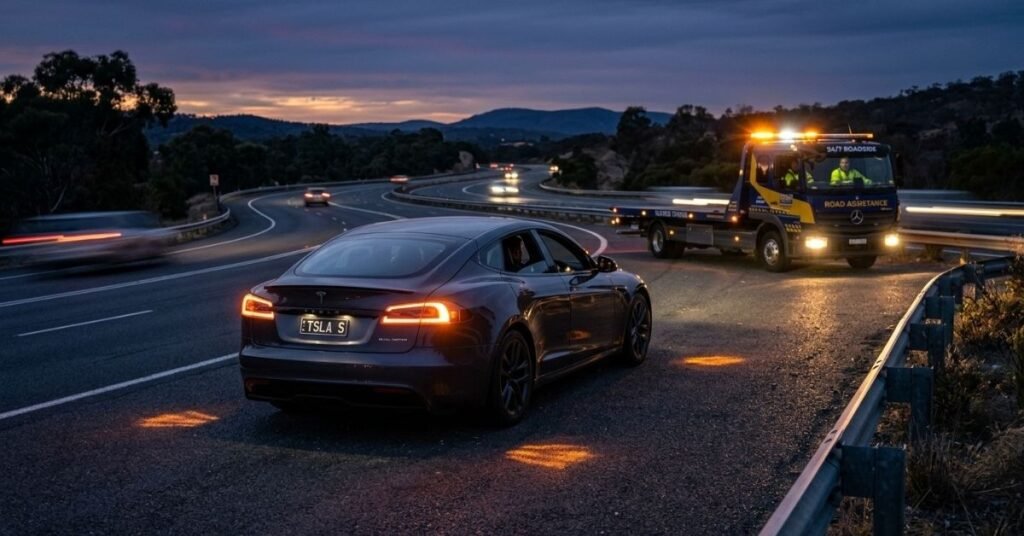
Once usable energy is exhausted, the Tesla can no longer propel itself. If this happens while driving, Tesla advises pulling over safely and contacting roadside assistance or a preferred tow provider.
A particularly important issue is the low-voltage system. Tesla’s Model 3 documentation explains that after the vehicle runs out of range, the low-voltage battery is no longer supported. Because the low-voltage system is needed for normal charging functions, an external power supply may be required before the high-voltage battery can accept a charge.
This is why a Tesla that has been driven completely out of range may not behave like a conventional car that can simply be refueled after being pushed to a station. The recovery procedure can require specialized roadside equipment.
If the vehicle is already stopped away from a charger, do not attempt to open high-voltage components or improvise electrical connections. Tesla warns that the high-voltage system should only be serviced by trained technicians.
Can You Charge a Tesla After It Hits 0%?
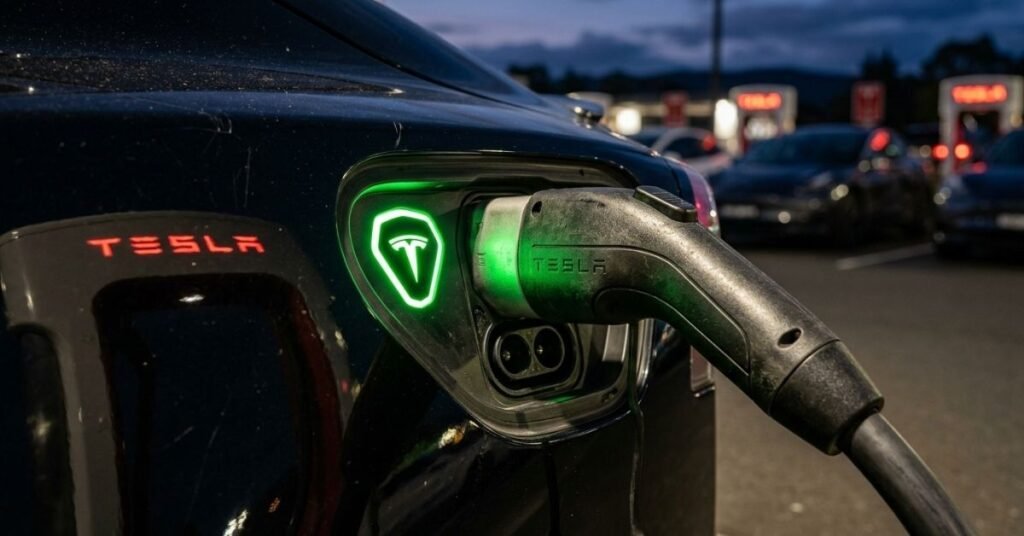
Often, yes, if the vehicle has only recently reached the displayed zero and the low-voltage system remains functional. The first step is to connect the car to a compatible charging source and verify that charging actually begins.
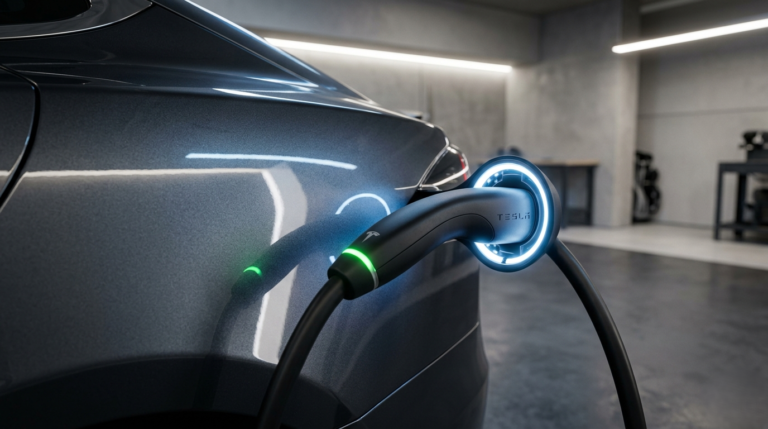
Tesla recommends checking the charge-port indicator. On Model 3 documentation, a blinking green light indicates charging is in progress, while red indicates a fault and stopped charging. Exact charging behavior and indicators can vary by vehicle and software version.
If the car does not respond, does not unlock, or will not begin charging after running out of range, the low-voltage battery may be discharged. Tesla documentation explains that the low-voltage system may need external support, and service may be necessary if normal charging cannot be restored.
Do not repeatedly attempt improvised jump-starting procedures unless the procedure is specifically provided for your exact Tesla model and situation. Tesla’s instructions differ by vehicle generation and low-voltage battery type.
Does Driving to 0% Damage a Tesla Battery?
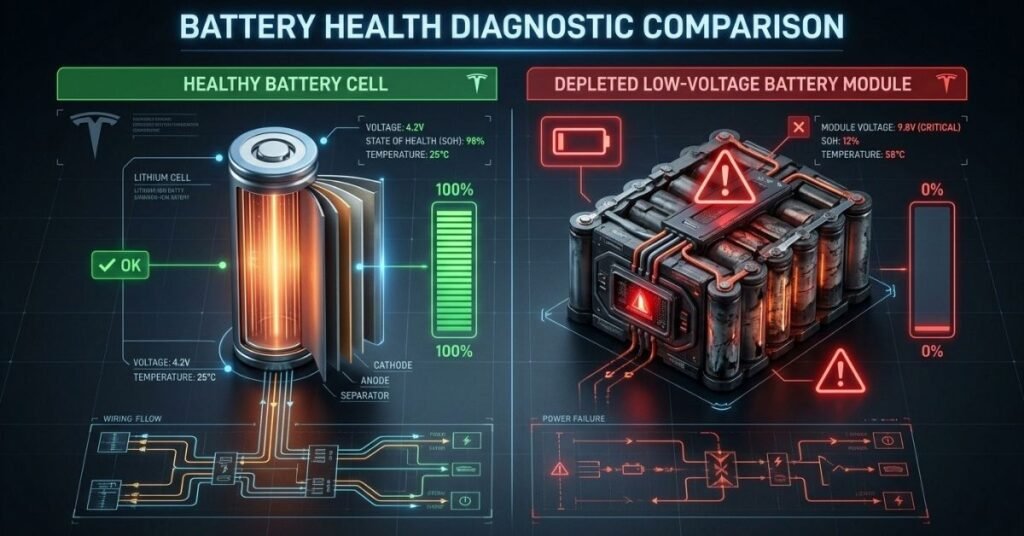
Reaching 0% once does not automatically mean the high-voltage battery has been permanently damaged. The greater concern is leaving the vehicle discharged for an extended period.
Tesla warns that allowing the battery to discharge to 0% can damage other components and may require replacement, including the low-voltage battery. Its manuals also warn that leaving a vehicle unplugged after reaching 0% for an extended period can lead to permanent battery damage.
Repeatedly operating at extremely low states of charge is also a poor ownership habit. Tesla recommends charging more frequently and avoiding leaving the battery near 0% or 100% for days or weeks.
Battery chemistry matters for long-term care, and recommended charging limits can differ between vehicles. Follow the charge-limit guidance shown in your Tesla’s touchscreen or mobile app rather than applying one rule to every model.
How Long Can a Tesla Sit at 0%?

There is no safe universal countdown such as “you have exactly 24 hours.” The vehicle continues to consume energy while parked, although the rate varies with temperature, configuration, settings, and active features.
Tesla notes that an idle, unplugged Model 3 can discharge at approximately 1% per day, although the actual rate varies. Once the displayed level approaches 0%, the vehicle can enter a low-power mode designed to reduce consumption. In that mode, the battery stops supporting onboard electronics and the auxiliary low-voltage battery.
That protection is not a storage recommendation. If you see 0%, plug the vehicle in as soon as possible. The longer it remains without charging, the greater the risk that the low-voltage battery becomes depleted and charging becomes more complicated.
What Should You Do If Your Tesla Says 0%?
If you are still driving, prioritize safety rather than squeezing out additional distance.
- Reduce speed and avoid unnecessary acceleration.
- Turn off nonessential energy-consuming features where practical.
- Navigate to the nearest compatible charger only if the car indicates that reaching it is realistic.
- Pull over safely if the vehicle begins losing power or cannot reach a charger.
- Contact Tesla Roadside Assistance or a qualified tow provider if you run out of range.
- Tell the recovery provider that the vehicle is an EV and has reached zero state of charge.
If the Tesla is already parked at home, connect it to your normal charging equipment immediately. Confirm that the charge indicator shows active charging before leaving the vehicle unattended.
If charging fails, check the vehicle’s alerts and follow Tesla’s model-specific instructions. If the vehicle is unresponsive, service or specialized roadside assistance may be required.
Does Cold Weather Make 0% More Dangerous?
Cold weather can make a low state of charge more difficult because battery performance and available power are affected by temperature. A cold battery can also limit charging and regenerative braking until it reaches a suitable operating temperature.
This means a range estimate that looks comfortable under mild conditions may become less useful in freezing weather. High-speed driving, heating, elevation changes, wind, and other loads can further increase energy consumption.
In hot climates, energy used by cooling and vehicle systems can also affect parked consumption. The key lesson is simple: do not plan to arrive at a charger with 0% as your target.
What About Different Tesla Models?
The basic principle applies across Tesla’s lineup: 0% should be treated as the end of usable driving range, not as a dependable reserve. However, exact warnings, battery chemistry, low-voltage architecture, charging behavior, and emergency procedures can differ.
Model 3 manuals, for example, explicitly describe low-power operation around a displayed 0% and explain the possible low-voltage consequences. Other Tesla models have their own owner documentation, so owners should use the manual for their exact vehicle and model year.
Battery type also matters for routine charging guidance. Some Teslas use lithium iron phosphate batteries, while others use different lithium-ion chemistries. Tesla’s software can provide battery-specific recommendations.
0% vs. Low Battery: What Is the Difference?
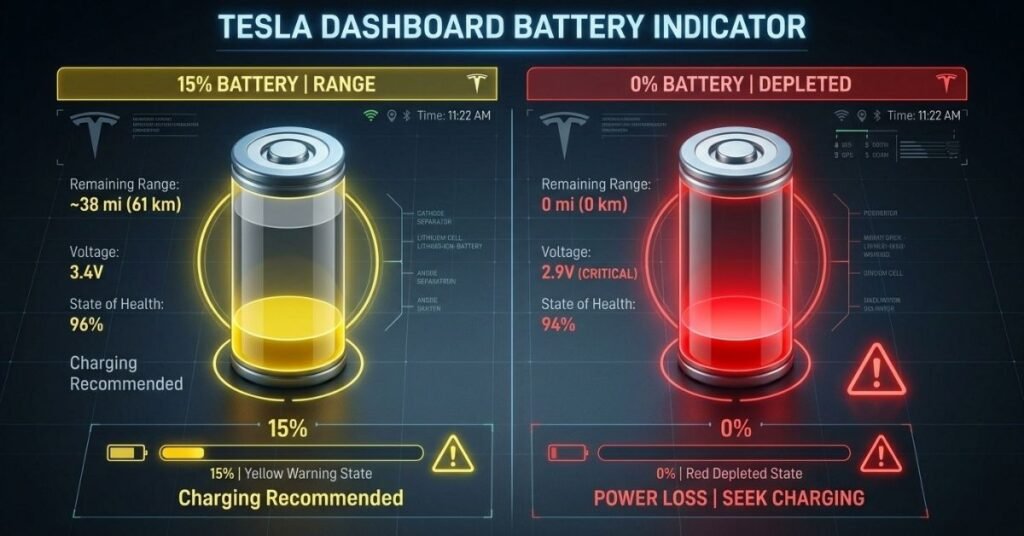
A low battery warning is a warning that you still have some usable energy. A displayed 0% means you should stop treating the vehicle as having usable range.
| Battery display | Practical meaning | Best action |
| 20% or below | Low state of charge | Plan charging soon |
| 10% | Very limited buffer | Charge as soon as practical |
| 5% | Emergency-level planning | Head directly to a charger |
| 0% | Do not assume range remains | Charge immediately or seek assistance |
| Out of range | Propulsion unavailable | Stop safely and arrange recovery |
These percentages are practical guidance, not universal Tesla thresholds for every model or software version.
Can a Tesla Restart After Showing 0%?
Sometimes a vehicle that has only recently reached displayed 0% may still respond normally enough to begin charging. That does not mean it has meaningful driving range left.
If it has actually run out of range and the low-voltage system has become unsupported, restarting the touchscreen or repeatedly selecting Drive will not restore usable propulsion. The vehicle needs energy and, depending on its condition, external low-voltage support or professional assistance.
Do not confuse a temporary display or communication issue with an empty battery. If the percentage suddenly behaves abnormally, charging fails repeatedly, or battery warnings remain after charging, schedule service.
Frequently Asked Questions
Is 0% really empty on a Tesla?
A displayed 0% means you should assume there is no usable driving range. The battery-management system protects the pack, but any remaining inaccessible energy should not be considered an emergency reserve.
Can I drive another mile at 0%?
You should not plan to. Tesla explicitly warns owners not to assume range is available when the display reaches 0 miles or 0%.
What if my Tesla reaches 0% at home?
Plug it in immediately and verify that charging begins. If it will not charge or becomes unresponsive, follow the model-specific Tesla manual or contact service.
Does 0% permanently damage the battery?
Not necessarily from one brief event. However, Tesla warns that extended discharge can damage vehicle components and may cause permanent battery damage.
Can roadside assistance tow a Tesla at 0%?
Yes, a qualified recovery provider can transport an out-of-range Tesla to a charging location. Tesla’s Model 3 guidance says the vehicle should be unloaded within reach of the charging cable.
Should I keep my Tesla near 0% when parked?
No. Tesla recommends avoiding leaving the battery near 0% for days or weeks and recommends regular charging.
Conclusion
Tesla battery 0 percent what happens is straightforward: treat it as the end of your usable driving range. The car may reduce power, stop, or enter low-power operation, and an extended stay at zero can create low-voltage and battery-related problems.
The smartest approach is prevention. Charge before the battery becomes critically low, keep a practical margin for weather and driving conditions, and respond immediately when the display reaches zero. One useful habit is to treat the final few percent as a planning buffer, not extra range. If a charger is farther away than expected, changing conditions can turn a manageable trip into an unnecessary roadside recovery event quickly.
If your Tesla actually runs out of range, get somewhere safe and use Tesla Roadside Assistance or a qualified EV recovery provider rather than attempting improvised high-voltage repairs. Following the owner manual for your exact model and market is the safest way to recover the vehicle and protect its battery system.