Tesla Stock Price: Latest TSLA Price, Trends, and Key Drivers
Tesla stock price is one of the most searched financial questions among investors, EV enthusiasts, and people trying to understand the company’s future. As of the latest completed U.S. trading session on August 28, 2026, Tesla shares (NASDAQ: TSLA) closed at $348.75. That is the most useful confirmed regular-market reference for readers on August 31 before the new session is underway. The bigger question, however, is not simply where TSLA trades today. It is why the market values Tesla at that level, what could move the stock next, and how investors should interpret the company’s changing business. Investors should also remember that a market quote reflects collective expectations, not a guarantee of Tesla’s future earnings, product success, or technological progress.
Quick Answer
The latest confirmed Tesla stock price is $348.75 per share at the August 28, 2026 regular-market close. TSLA was down 1.71% that session. Overnight trading later showed $347.18, but overnight prices are not the same as the official regular-session close. Tesla’s valuation remains highly sensitive to vehicle demand, profitability, artificial intelligence, autonomy, energy storage, capital spending, interest rates, and investor expectations. Prices can change rapidly, so always check a live market quote before making a financial decision.
Tesla Stock Price Today: What the Number Means

A share price tells you what investors are currently willing to pay for one share of Tesla. It does not, by itself, tell you whether Tesla is cheap or expensive.
For example, a $348 stock could be inexpensive if a company generates enormous and rapidly growing profits. Conversely, the same price could be expensive if future earnings fail to justify the valuation. That is why serious analysis starts with market capitalization, revenue, earnings, cash flow, growth expectations, and valuation multiples rather than the share price alone.
Tesla is particularly unusual because investors often value it as more than an automaker. Its business includes automotive sales, energy generation and storage, charging-related services, software, artificial intelligence, and autonomy ambitions. The market therefore tries to estimate not only Tesla’s current earnings but also the potential value of businesses that may become more important over time.
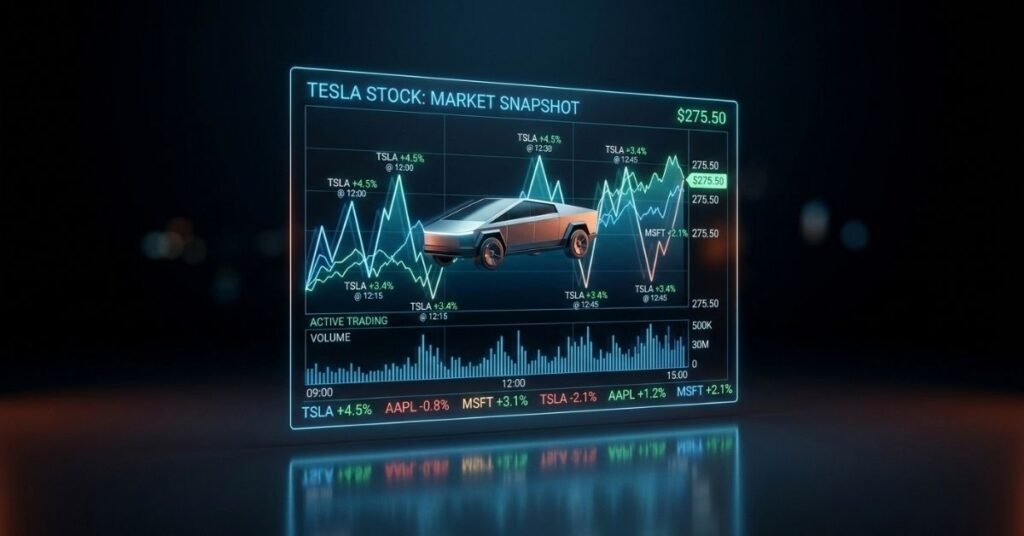
The latest trading history illustrates the volatility. TSLA closed at $362.86 on August 21, then $348.95 on August 24, $350.25 on August 25, $345.82 on August 26, $354.81 on August 27, and $348.75 on August 28. Those movements show why a single-day quote should not be mistaken for a long-term trend.
Why Tesla Stock Moves So Much
Tesla’s stock can react sharply to information that changes expectations about future growth. Vehicle deliveries are one obvious factor, but they are only part of the picture.
Tesla reported 480,126 vehicle deliveries for the second quarter of 2026 and deployed 13.5 GWh of energy storage products.During the quarter, the company produced 451,758 vehicles. These figures provide evidence about demand and manufacturing scale, but Tesla itself warns that deliveries alone do not determine quarterly financial performance. Revenue also depends on average selling prices, product mix, costs, foreign exchange movements, and other factors.
Profitability can matter even more than volume. Investors watch automotive gross margin, operating margin, free cash flow, and earnings per share because increasing deliveries do not automatically create increasing profits. Discounts, financing incentives, factory utilization, commodity costs, and spending on new programs can change the relationship between sales and earnings.
Tesla’s Q2 2026 filing reported total revenue of $28.236 billion for the quarter, compared with $22.496 billion a year earlier. Automotive sales revenue increased 27% year over year, while the company also pointed to higher revenue associated with FSD Supervised subscriptions and changes in sales mix. Those numbers help explain the business underneath the stock chart.
The Biggest Drivers Investors Watch
Vehicle Demand
Model 3 and Model Y remain central to Tesla’s automotive business. Investors monitor deliveries, pricing, inventory, regional demand, and competitive pressure. Strong unit growth can support the stock, but declining average selling prices can reduce the benefit of higher volume.
Competition is also global. Tesla faces established automakers and EV specialists across North America, Europe, China, and other Asian markets. Local incentives, tariffs, import rules, financing conditions, and consumer preferences can materially affect demand.
Energy Storage
Tesla’s energy business has become an increasingly important part of the investment story. Megapack and related energy products can provide revenue growth that is less directly tied to passenger-vehicle demand.
For investors, the important questions include deployment growth, manufacturing capacity, margins, project economics, and whether energy can become a larger contributor to overall earnings.
Artificial Intelligence and Autonomy
Tesla’s valuation is also influenced by expectations surrounding artificial intelligence, autonomous driving, robotaxis, and related software. This is where expectations can become particularly difficult to price.
A future autonomy business could be economically significant if Tesla can deploy reliable systems at scale and operate them legally in relevant markets. But software capability, regulatory approval, liability frameworks, customer acceptance, and commercial economics remain separate questions. Investors should distinguish Tesla’s stated ambitions from proven financial results.
Capital Spending
Growth requires investment. Tesla is spending heavily on factories, computing, artificial intelligence infrastructure, energy capacity, and future products. Capital expenditure can support future revenue, but it can also pressure free cash flow in the near term.
That tradeoff matters when evaluating TSLA. A large investment program may be rational if it creates high-return businesses later, yet shareholders still face execution risk if projects take longer, cost more, or produce lower returns than expected.
Tesla Valuation: Why Price Alone Is Not Enough

The most useful way to interpret Tesla stock price is to connect it with valuation.
Market capitalization equals share price multiplied by shares outstanding. Investors can then compare that value with revenue, operating income, net income, free cash flow, or other measures. Common valuation metrics include price-to-earnings, price-to-sales, enterprise value to EBITDA, and price-to-free-cash-flow.
Tesla’s valuation can look very different depending on which measure is emphasized. A traditional automaker comparison may make the stock appear expensive, while a more optimistic framework that assigns substantial value to energy, software, autonomy, robotics, or AI can produce a different conclusion.
Neither approach should be accepted automatically. The key question is how much future success is already reflected in the market price.
Tesla Stock Price Forecasts: What Investors Should Know
Searches for “Tesla stock price prediction” often produce precise targets for future years. Those numbers can be useful as expressions of analyst assumptions, but they are not guarantees.
Forecasts depend on assumptions about deliveries, margins, interest rates, competition, autonomy adoption, energy growth, product launches, and valuation multiples. Small changes in those assumptions can produce dramatically different targets.
A better approach is to think in scenarios.
A bullish scenario might involve strong vehicle demand, expanding energy deployments, improving profitability, successful autonomy commercialization, and disciplined capital allocation. A neutral scenario could involve steady automotive growth while newer businesses take longer to contribute. A bearish scenario could include weaker demand, margin pressure, high spending, stronger competition, regulatory setbacks, or delayed new products.
Scenario analysis is more useful than treating one analyst’s target as destiny.
Global Factors That Affect TSLA

Tesla is a multinational company, so investors should not interpret its business through a single-country lens.
In the United States, interest rates, consumer incentives, regulatory decisions, and domestic production influence demand and costs. Canada has its own incentive and market conditions. Europe and the United Kingdom operate under different emissions rules, taxes, charging infrastructure, and consumer incentives. China is especially important because it is both a major EV market and a major manufacturing base for Tesla.
Currency movements can also affect reported results. Tesla sells vehicles and energy products internationally, while financial reporting is conducted in U.S. dollars. Exchange-rate changes can therefore influence reported revenue and profitability even when underlying local-currency activity changes less dramatically.
Import duties, tariffs, local manufacturing requirements, tax policies, and government incentives can change Tesla’s competitive position from one market to another.
Tesla Stock Price vs. Tesla Business Performance

One of the most important lessons for investors is that the stock and the business are related, but they are not identical.
A strong quarter does not guarantee a rising share price. If investors expected even better results, the stock can fall after positive earnings. Likewise, a disappointing quarter can sometimes be followed by a rising stock if the market believes future conditions will improve.
Expectations are the bridge between financial results and valuation.
That is why Tesla investors should track quarterly reports, management guidance, production and delivery figures, cash flow, margins, and major strategic developments rather than watching the quote alone. Tesla’s Investor Relations site provides the company’s quarterly disclosures, earnings materials, SEC filings, and other official updates.
Pros and Cons of Investing in Tesla
Pros
- Tesla has a large global EV manufacturing and sales footprint.
- Its energy storage business offers another potential growth engine.
- Software, AI, and autonomy could create higher-margin businesses if successfully commercialized.
- The company has substantial brand recognition and an established charging ecosystem in many markets.
- Its stock offers significant exposure to multiple technology and mobility themes.
Cons
- TSLA can be extremely volatile.
- Automotive competition is intensifying globally.
- High expectations can make valuation sensitive to execution.
- Heavy investment can pressure near-term cash flow.
- Autonomy and robotaxi opportunities involve substantial technical, regulatory, and commercial uncertainty.
- Regional sales, pricing, and incentives can change quickly.
Who Should Pay Attention to Tesla Stock?
Tesla stock is most relevant to investors comfortable analyzing high-growth companies with substantial uncertainty. It may appeal to people who believe Tesla can expand beyond conventional vehicle manufacturing and successfully build large energy, software, AI, or autonomy businesses.
It may be less suitable for someone seeking predictable income, low volatility, or a straightforward valuation based primarily on current automotive earnings.
Anyone considering an investment should evaluate personal risk tolerance, diversification, time horizon, and financial circumstances. The fact that a stock is popular does not make it appropriate for every portfolio.
Frequently Asked Questions
What is the latest Tesla stock price?
Tesla closed at $348.75 on August 28, 2026, the latest completed regular U.S. trading session available before August 31. Live prices can change once the market opens.
What is Tesla’s stock ticker?
Tesla trades on the Nasdaq under the ticker symbol TSLA.
Is Tesla stock a good investment?
There is no universal answer. The decision depends on valuation, expected growth, risk tolerance, portfolio diversification, and your view of Tesla’s future earnings and businesses.
Why is Tesla stock so volatile?
TSLA combines a large automotive business with expectations surrounding AI, autonomy, energy, and future products. Changes in any of these expectations can produce significant price movements.
Does Tesla pay a dividend?
Tesla does not currently pay a regular cash dividend. Investors generally rely on potential share-price appreciation rather than dividend income.
Should I use a Tesla stock price target?
A target can help illustrate an analyst’s assumptions, but it should not be treated as a guaranteed future price. Compare several scenarios and examine the assumptions behind each forecast.
Where can I verify Tesla financial information?
Tesla’s Investor Relations website provides quarterly updates, earnings materials, SEC filings, production and delivery releases, and other company disclosures. These are preferable to relying on social-media claims.
Conclusion
The latest confirmed Tesla stock price is $348.75 based on the August 28, 2026 regular-market close. But the number becomes meaningful only when placed beside Tesla’s financial performance, valuation, growth expectations, competitive position, and future investment requirements.
Tesla remains a complex stock because its value reflects both a large EV business and expectations for energy, AI, autonomy, software, and future products. The most reliable way to follow TSLA is to separate confirmed results from forecasts, watch the company’s financial disclosures, and recognize that market prices can change long before the underlying business does.
For a global investor, regional conditions matter too. Currency, taxes, incentives, competition, regulations, and market demand differ across countries. Before buying or selling TSLA, verify the current quote, review the latest company filings, and consider whether the investment fits your own objectives and risk tolerance.