Tesla Horsepower Model 3: Complete Power Guide for 2026
If you are searching for tesla horsepower model 3, the first thing to know is that there is no single horsepower number for every Model 3. Power depends on the model year, drivetrain, motor configuration, and market. Tesla also does not publish a horsepower figure for every current trim in every country, which is why third-party specifications can disagree. The current Model 3 range spans efficient rear-wheel-drive versions to the dual-motor Performance, with a large gap in power between them. This guide explains what the available figures mean, how horsepower affects acceleration, and which Model 3 is the better fit for different drivers.
Quick Answer
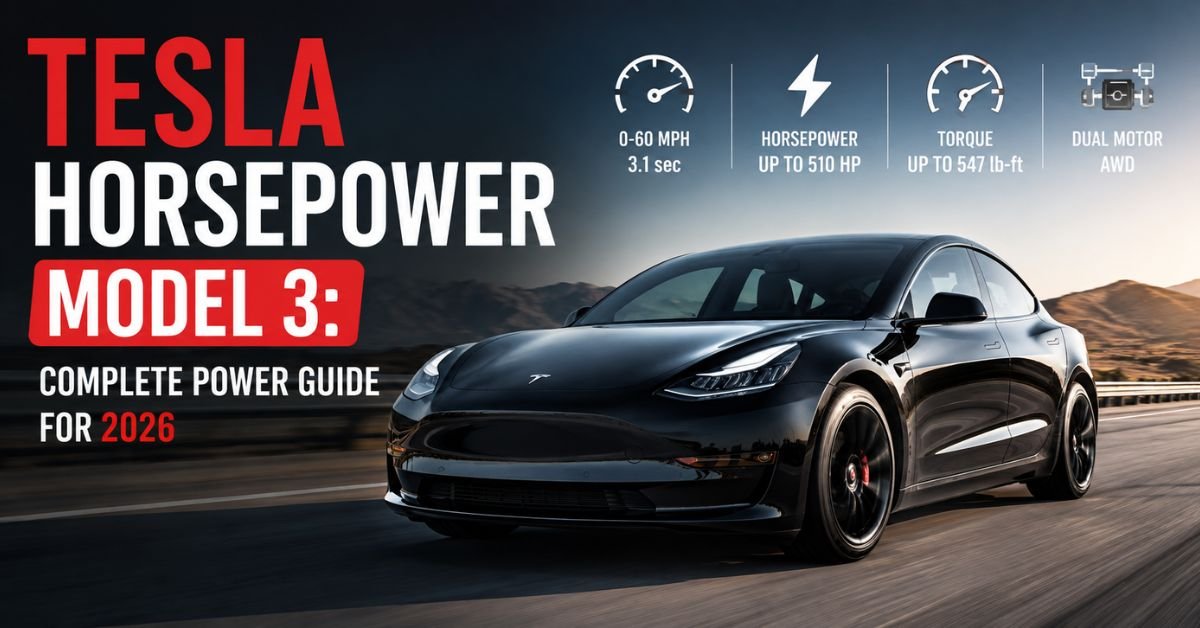
The 2026 Tesla Model 3 Performance is the clearest answer to the horsepower question: Tesla lists 510 hp of peak power for its latest Performance drive unit. Other Model 3 versions have less power, but Tesla does not consistently publish official horsepower figures for every trim. Treat third-party figures as estimates rather than universal Tesla ratings. Tesla’s official Performance specification confirms 510 hp and rapid acceleration.
Tesla Horsepower Model 3: Why the Number Varies
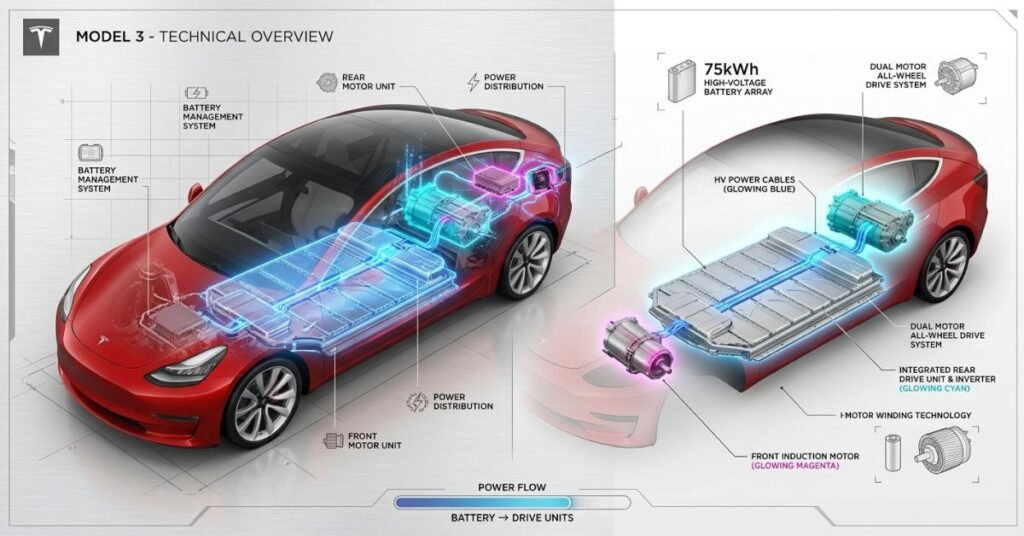
A gasoline car usually has an engine horsepower rating that is easy to compare across trims. An EV is more complicated. The Model 3 uses electric motors, a high-voltage battery, power electronics, and software that coordinate how much power reaches the wheels.
Tesla can also change its motor hardware, battery chemistry, inverter calibration, and software without making every change obvious from the vehicle’s name. That means two Model 3 cars carrying similar trim names can have different performance characteristics depending on model year and market.
For the lineup, Tesla’s official pages identify the Performance model as a dual-motor all-wheel-drive sedan with 510 hp, a 0-100 km/h time of as little as 3.1 seconds, and a top speed around 262 km/h in markets using those specifications. Tesla’s U.S. site lists 510 hp, 2.9 seconds to 60 mph, and a 163-mph top speed. These figures show why the Performance sits in a different performance category from the everyday versions.
How Much Horsepower Does Each Model 3 Have?
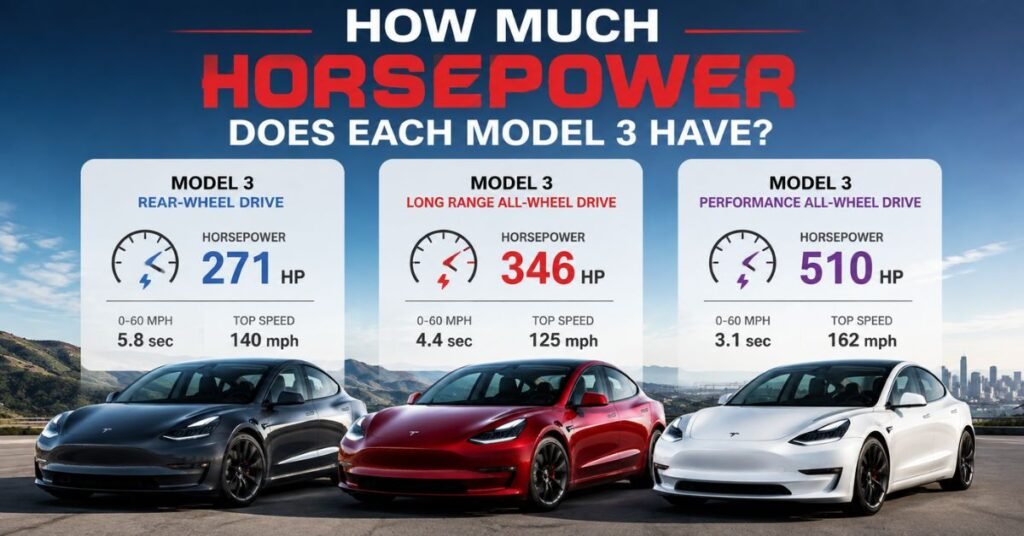
Because Tesla’s official documentation does not provide a single worldwide horsepower table for every trim, the safest approach is to separate Tesla’s published figure from third-party estimates.
| Model 3 version | Drive | Common published power figure | Performance context |
| Standard/Base RWD | Single motor | About 271–286 hp | Efficiency-focused |
| Premium RWD | Single motor | About 295 hp | Balanced daily driving |
| Premium Long Range RWD | Single motor | Not consistently published | Long-range focus |
| Premium Long Range AWD | Dual motor | About 425 hp | Strong all-weather performance |
| Performance | Dual motor AWD | 510 hp | Maximum Model 3 performance |
The table should not be treated as a permanent worldwide specification sheet. Trim names, equipment, batteries, and available configurations can differ by country and can change over time. Tesla’s support documentation, for example, lists several current Model 3 configurations and separate earlier versions by model year.
For buyers, acceleration and drivetrain are often more useful than horsepower alone. Tesla’s current Performance is officially rated at 3.1 seconds from 0 to 100 km/h in several international markets. Car and Driver tested a 2026 Model 3 Performance at 2.8 seconds to 60 mph.
Why Tesla Does Not Always Publish Horsepower
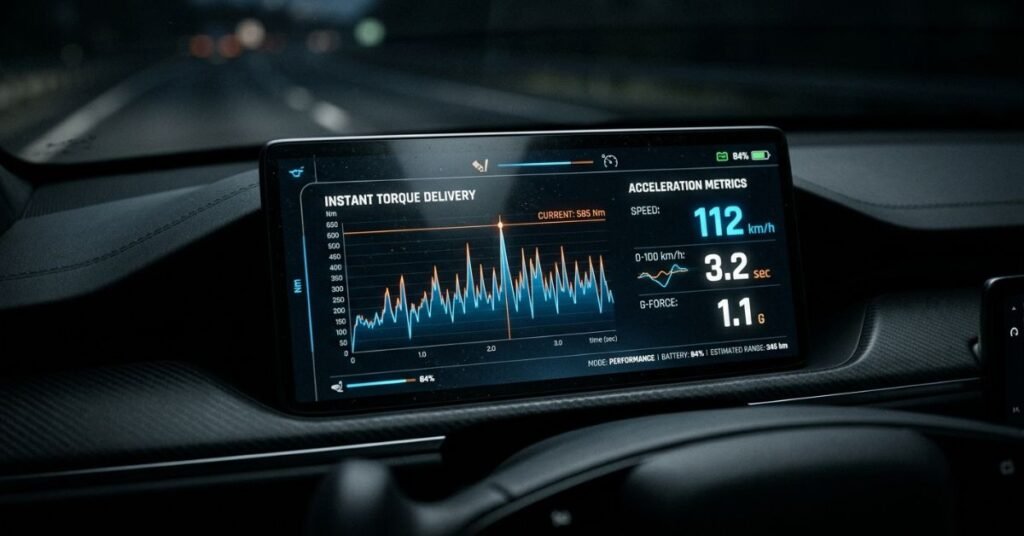
Tesla’s product pages tend to emphasize range, acceleration, charging, drivetrain, and other ownership metrics rather than publishing engine-style horsepower figures for every vehicle. That creates confusion when shoppers compare the Model 3 with BMW, Mercedes-Benz, Hyundai, or gasoline-powered sports sedans. This does not mean horsepower is irrelevant. It means the number needs context.
An EV can deliver substantial torque almost immediately because its motor does not need to build revs like a conventional internal-combustion engine. The Model 3 can therefore feel much quicker than a horsepower comparison alone might suggest. Tire grip, vehicle weight, gearing, traction control, battery output, and software calibration all influence the result.
For example, a lower-powered rear-wheel-drive Model 3 can still feel responsive in city driving because electric torque arrives quickly. The Performance adds another level through dual motors, all-wheel drive, stronger thermal management, performance-oriented hardware, and software designed for rapid acceleration.
Horsepower vs. Acceleration
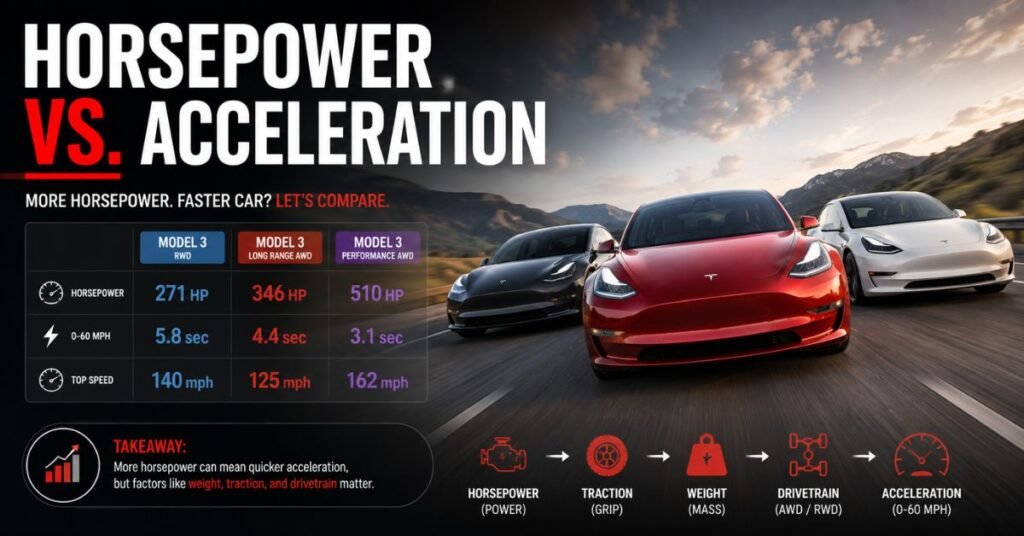
Horsepower tells you about power output. Acceleration tells you what the complete vehicle can actually do.
That difference matters with the Model 3. A Performance model’s 510 hp works with two motors and all-wheel drive to put power down effectively. Tesla also equips the Performance with adaptive damping, performance brakes, 20-inch wheels, performance tires, and aerodynamic changes. The result is more than a larger number on a specification sheet.
Independent testing reinforces this point. Car and Driver recorded a 2.8-second 0-to-60-mph run for the Model 3 Performance. In its 2026 Lightning Lap testing, the same generation of Performance achieved a 2:58.4 lap at Virginia International Raceway, although the publication also observed power reduction as temperatures rose during hard track use.
That last detail is useful for understanding EV performance. Maximum peak power does not mean the car can sustain maximum output indefinitely. On a road, the difference may rarely matter. On a racetrack, repeated high-load acceleration can bring battery and motor temperatures into play.
What Makes the Model 3 Performance More Powerful?
The Model 3 Performance is not simply a regular Model 3 with a software switch. Tesla says its latest Performance drive unit is the most powerful drive unit fitted to the Model 3 and delivers 510 hp.
The car’s dual-motor all-wheel-drive system is central to its acceleration. Front and rear motors can manage traction more effectively than a single driven axle, especially when the vehicle is launching hard or exiting a corner.
Tesla also added chassis hardware aimed at handling the extra performance. Depending on market and model year, the Performance includes adaptive damping, upgraded brakes, performance tires, forged or performance-oriented wheels, aerodynamic revisions, and a lower, more focused setup.
The package is designed to support braking, cornering, traction, and spirited driving as well.
Does More Horsepower Mean Less Range?
Usually, a performance-focused Model 3 trades some efficiency for capability, but the relationship is not simply horsepower versus range.
The Performance has larger wheels, wider performance tires, a dual-motor system, and hardware optimized for speed. Those choices can increase energy consumption. Tesla’s international specifications show the Performance with lower rated range than the long-range rear-wheel-drive version.
Testing standards also matter. Europe and many other markets use WLTP, while the United States uses EPA estimates. Neither number guarantees the distance you will drive in everyday conditions. Speed, temperature, wind, elevation, traffic, climate control, tire pressure, wheels, and driving style can all change actual range.
For that reason, someone who values maximum highway distance may prefer a long-range RWD Model 3 even if its horsepower figure is less impressive. Someone who values acceleration and handling may accept shorter range in exchange for Performance hardware.
Global Market Differences Matter
The Model 3 is sold in multiple markets, but the lineup is not identical worldwide. Tesla’s websites in Australia, Singapore, Canada, the United Kingdom, the United States, and other countries can display different trim names, power figures, warranties, range tests, and equipment.
For example, Tesla currently lists 510 hp for Model 3 Performance in Canada and uses 343 kW for the same Performance power figure in Australia. Those are equivalent expressions of peak power because 1 horsepower is approximately 0.746 kilowatts.
Range is another example of regional variation. Tesla may show EPA estimates in the United States and WLTP figures in Europe, Asia, and other markets. A buyer should therefore use the Tesla page for their delivery country rather than copying a specification from another region.
Used-car shoppers need even more caution. Model 3 powertrains have changed over the years, and older RWD, Long Range, and Performance vehicles should be identified by model year, drivetrain, battery, and motor configuration before comparing horsepower.
Is 510 Horsepower Enough for a Model 3?
For most drivers, 510 hp is far beyond what is needed for normal transportation. It is nevertheless useful because horsepower gives the Performance substantial acceleration potential when traction, battery charge, temperature, and road conditions allow it.
Public roads have speed limits, traffic, pedestrians, cyclists, and unpredictable hazards, so the Performance should not be evaluated only by acceleration.
For daily use, lower-powered Model 3 versions can make more sense because they emphasize efficiency, range, comfort, or value. The Performance suits drivers who specifically want maximum factory acceleration and sharper handling.
Pros and Cons of High Output Model 3
Pros
- Very strong acceleration.
- Dual-motor all-wheel-drive traction.
- Performance-focused suspension and brakes.
- Excellent straight-line performance for its class.
- Strong software integration and adjustable driving features.
Cons
- Higher purchase cost than less powerful versions.
- Performance tires and larger wheels can cost more to replace.
- Higher energy consumption is possible.
- Maximum output can be limited by thermal conditions during repeated hard use.
- Not every market offers the same configuration or specification.
Who Should Choose Each Power Level?
A base or Standard-style RWD Model 3 is a sensible choice for drivers who prioritize efficiency and everyday transportation. It is especially attractive when purchase price and running costs matter more than rapid acceleration.
Premium RWD or long-range RWD models suit buyers who want a balanced daily EV. Depending on market, these versions can provide long driving range without paying for the additional hardware of the Performance.
Long Range AWD is a useful middle ground where available. Its dual motors provide extra traction and stronger acceleration while retaining a more practical focus than the Performance.
The Performance is for buyers who actively want the fastest Model 3 experience. Its 510-hp rating, dual motors, performance chassis, and rapid acceleration make it the enthusiast choice, but its higher cost and efficiency trade-offs should be part of the decision.
Frequently Asked Questions
Is the Tesla Model 3 Performance 510 hp?
Yes. Tesla currently lists 510 hp of peak power for the Model 3 Performance in several markets. Tesla’s U.S. page also lists 510 hp.
How much horsepower does a base Model 3 have?
Tesla does not consistently publish a universal horsepower rating for the base Model 3. Current third-party specifications commonly place some base RWD versions in the high-200-horsepower range, but the exact figure can vary with model year and motor.
Is 500 hp a lot for an EV?
Yes. In a compact sedan, roughly 500 hp is a very high output level. Acceleration also depends on traction, torque delivery, gearing, battery output, vehicle weight, and software.
Does horsepower affect Tesla range?
Power output itself is not the only factor. A performance configuration may use larger wheels, stickier tires, and more energy during aggressive driving, all of which can reduce efficiency.
Is Model 3 Performance faster than Model 3 Long Range?
Generally, yes. The Performance is designed for maximum acceleration and has dual-motor all-wheel drive. Exact acceleration figures vary by model year and market.
Does Tesla publish horsepower for every Model 3?
No. Tesla publishes peak power for the Performance, but horsepower information for other trims is often absent from Tesla’s consumer pages. Third-party figures should therefore be treated as estimates.
Is Tesla horsepower the same as gasoline-car horsepower?
Horsepower is the same unit of power, but EV power delivery differs. Electric motors can deliver torque rapidly, so two cars with similar horsepower can feel very different.
Conclusion
The answer to the tesla horsepower model 3 question depends on which Model 3 you mean. For the current Performance, Tesla officially lists 510 hp, making it the most powerful Model 3 in the present lineup. Other versions are less powerful and are better understood through their drivetrain, acceleration, range, and intended role rather than a single horsepower number.
For buyers worldwide, the smartest approach is to verify the exact model year, trim, motor configuration, and Tesla specifications for your market. If maximum acceleration is the priority, the Performance stands out. If efficiency, range, comfort, or value matters more, a lower-output Model 3 may be the better choice. Horsepower is important, but the complete powertrain is what determines how the car actually performs.