Tesla Regenerative Braking Explained: How It Works
If you are new to electric vehicles, Tesla regenerative braking can feel strange at first. Lift your foot from the accelerator and the car may slow noticeably without the brake pedal being touched. That deceleration is not wasted energy: the electric motor operates in reverse as a generator, converting part of the vehicle’s motion into electrical energy that can return to the high-voltage battery. This Tesla regenerative braking explained guide covers how the system works, why it improves efficiency, when regeneration is reduced, how it differs from conventional braking, and how to drive smoothly with it.
Quick Answer
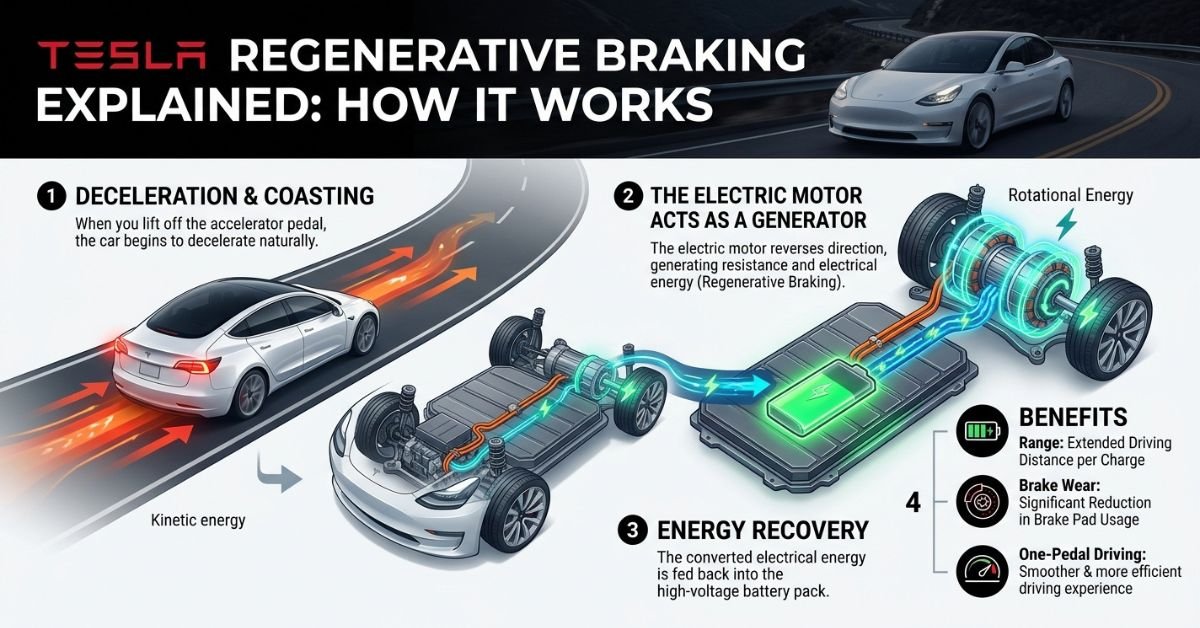
Tesla regenerative braking slows the vehicle when you ease off the accelerator and uses the drive motor to recover some kinetic energy as electrical energy. The recovered energy is sent back to the battery instead of being lost entirely as heat through friction brakes. Regeneration can improve efficiency and reduce brake wear, but its strength varies. Battery temperature, state of charge, traction, vehicle configuration, and software can affect it.
How Tesla Regenerative Braking Works
A conventional gasoline car usually converts motion into heat when its friction brakes slow the wheels. A Tesla can use its electric drive motor to slow the vehicle before the hydraulic brakes need to do most of the work.
When you accelerate, battery energy flows to the motor, creating torque. When you lift off the accelerator, the control system can reverse the motor’s energy flow. As a generator, the wheels drive the motor. Some of the vehicle’s kinetic energy becomes electrical energy and flows back toward the battery.
Because conversion and other system losses remain, only a portion of the energy can be recovered. Still, recovering a portion of otherwise wasted energy can improve overall vehicle efficiency.
Tesla’s owner manuals describe regeneration as occurring when the vehicle is moving and the accelerator is released. Depending on the model and conditions, regenerative braking may also contribute when the brake pedal is pressed. Behavior can vary with software and configuration.
What Happens When You Lift Off the Accelerator?
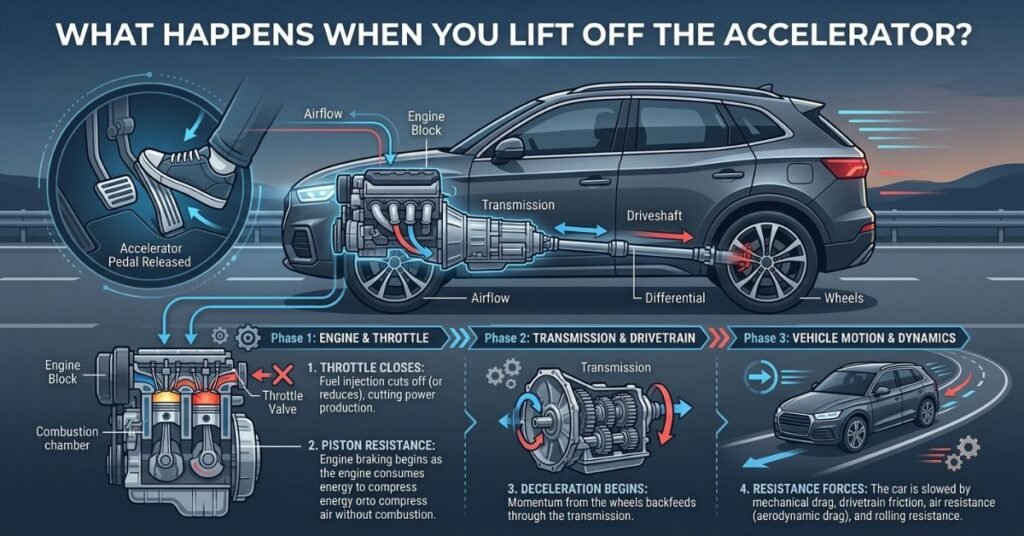
The most noticeable difference for a new Tesla driver is one-pedal-style driving. With suitable regenerative braking available, releasing the accelerator produces deceleration. Instead of immediately moving your foot to the brake pedal, you can modulate the accelerator to control speed.Approaching a traffic light, lift the accelerator earlier and let the vehicle slow. Use the brake pedal when needed.
This is especially useful in city traffic, where frequent deceleration creates opportunities for recovery. Tesla recommends anticipating stops and reducing accelerator pressure.
Regenerative braking does not mean you should avoid the brake pedal when it is needed. Safety takes priority. For emergency stops, press the brake pedal firmly and follow the vehicle’s braking guidance.
Regenerative Braking vs. Friction Braking
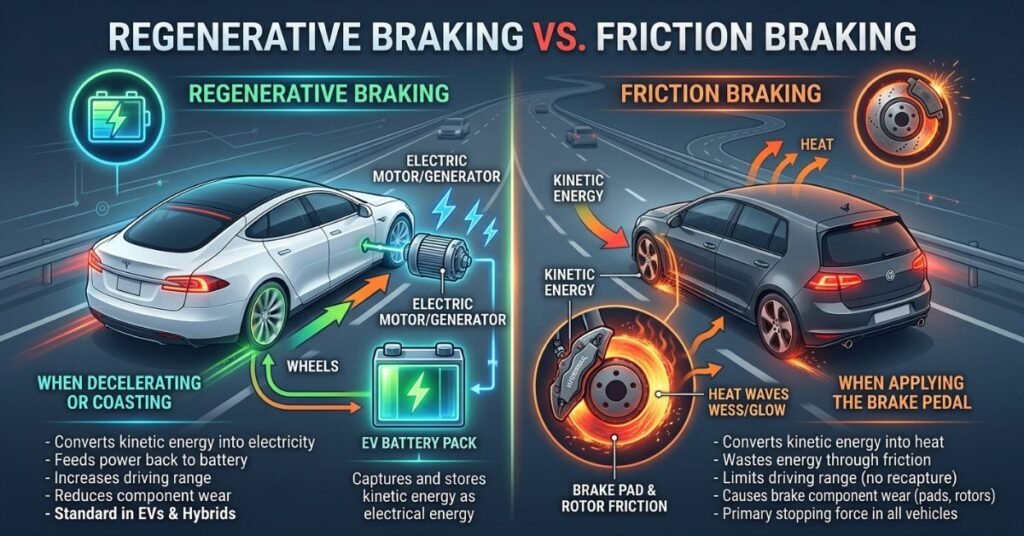
The two systems perform different jobs.
| Feature | Regenerative braking | Friction braking |
| Main purpose | Slow the vehicle while recovering energy | Slow or stop the vehicle |
| Energy result | Some energy returns to battery | Energy becomes heat |
| Brake-pad use | Often reduced | Required when friction braking is used |
| Battery dependent | Yes | No, within normal braking-system operation |
| Best use | Gradual deceleration | Strong or final braking |
Tesla vehicles can blend regenerative and conventional braking according to conditions. Drivers do not manually choose the system at every stop.
Regeneration depends on whether the battery can accept recovered energy. If restricted, the vehicle may use conventional brakes. Tesla manuals explain that braking behavior can change when regenerative braking is limited.
Why Regenerative Braking Can Be Limited

One of the most common Tesla questions is why regenerative braking sometimes feels weaker. The answer is usually related to system conditions rather than a mechanical problem.
A Cold Battery
A cold high-voltage battery may not be able to accept regenerative power at the same rate as a warmer battery. Tesla states that regenerative braking can be limited when the battery is cold. As the battery warms during driving, available regenerative power can increase.
A blue snowflake indicator can appear when some stored battery energy is temporarily unavailable because the battery is cold, and Tesla notes that regenerative braking, acceleration, and charging can be limited.
Preconditioning before departure can help prepare the battery and cabin, particularly in cold climates.
A Nearly Full Battery
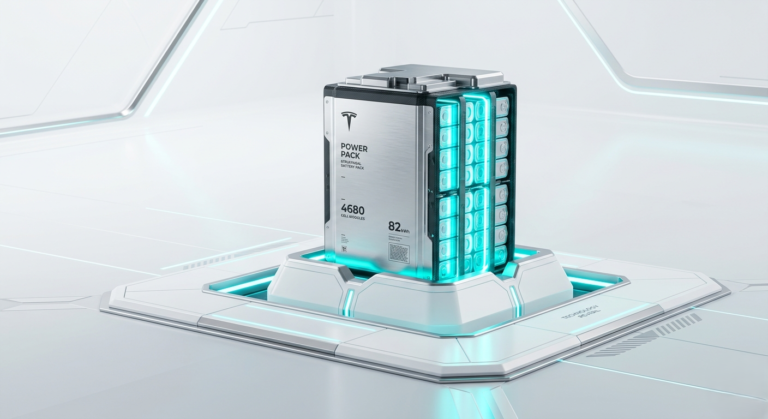
Regeneration sends energy into the battery, so a battery with little room remaining cannot accept unlimited additional energy. Tesla manuals therefore warn that regenerative braking may be limited when the battery is already fully charged.
This is why a Tesla can feel different immediately after charging to a high state of charge. Do not assume a change in lift-off deceleration automatically indicates a fault.
Traction and Road Conditions
Regenerative braking still acts through the driven wheels. On snow or ice, strong deceleration at those wheels can affect traction. Tesla warns that regenerative braking can contribute to loss of traction in slippery conditions and, on applicable vehicles, recommends a lower regenerative setting for snowy or icy roads.
Tire choice also matters. Tesla notes that some winter tires can temporarily reduce regenerative braking power while the vehicle recalibrates.
Does Regenerative Braking Increase Tesla Range?

Yes, it can improve efficiency, but regeneration is not free energy.
When a Tesla accelerates, the battery supplies energy. During deceleration, regenerative braking can recover part of that energy. Because the recovery process has losses, the car cannot return every unit of energy previously consumed.
The benefit is greatest with repeated slowing, such as urban driving and controlled downhill speed reduction. A steady highway drive offers fewer recovery opportunities.
Driving style still matters. Tesla recommends smooth acceleration and braking, while its range guidance notes that hard braking can reduce regenerative efficiency. High speed, weather, climate control, tires, terrain, and other factors can also influence energy consumption.
Think of regeneration as energy recovery, not an energy bonus.
How to Use Tesla Regenerative Braking Efficiently
Look farther ahead.
Instead of accelerating toward a red light and then braking late, release the accelerator earlier and allow the Tesla to slow progressively. This gives regenerative braking more opportunity to recover energy while reducing unnecessary friction-brake use.
Useful habits include:
- Anticipate traffic lights and slowing vehicles.
- Make gradual accelerator adjustments.
Leave the appropriate following distance.
- Use the brake pedal whenever stronger braking is necessary.
- Avoid treating maximum regeneration as a substitute for safe braking.
- In cold weather, expect reduced regeneration until the battery warms.
- Watch the power meter.
Tesla’s power meter can show energy being recovered through regeneration, helping drivers understand how their inputs affect efficiency.
Does Regenerative Braking Wear Out the Battery?
Regenerative braking does return energy to the high-voltage battery, so it is reasonable to ask whether that process creates additional battery wear. However, normal vehicle operation is managed by Tesla’s battery and power electronics systems, which control charging and discharging within operating limits.
There is no sensible rule that says every regenerative-braking event causes a specific amount of battery degradation. Battery aging is influenced by many factors, including time, temperature, charging patterns, energy throughput, and battery chemistry.
Use regenerative braking normally; there is no need to avoid ordinary regeneration.
Do Tesla Brake Pads Last Longer?
They can, because regenerative braking can handle much of the routine deceleration that would otherwise require friction brakes. Tesla explicitly notes that brake pads are typically used less frequently in vehicles with regenerative braking.
Less friction-brake use can reduce pad wear, but it does not mean the physical brakes can be ignored. Tesla vehicles still use conventional braking hardware for situations where stronger braking is required and when regeneration is unavailable or limited.
Infrequent friction-brake use can allow disc rust or corrosion, especially where roads are salted. Tesla uses brake-disc wiping on applicable vehicles.
Does Every Tesla Have the Same Regenerative Braking?
No. Regenerative-braking behavior can differ between Tesla models, model years, software versions, battery configurations, drive systems, tire setups, and market-specific configurations.
Tesla’s manuals for Model 3, Model Y, Model S, and Model X all describe regenerative braking, but the available controls and wording can differ. Some vehicles provide settings that alter the amount of regenerative deceleration, while other configurations may offer different controls or automatic behavior.
Software updates can also change vehicle behavior. Always check the owner’s manual for your specific Tesla and current software version rather than assuming that another Tesla operates identically.
Pros and Cons
Pros
- Recovers some energy during deceleration.
- Can improve efficiency, particularly in stop-and-go driving.
- Reduces reliance on friction brakes.
- Can make one-pedal-style driving convenient.
- Helps control speed on many downhill sections.
Cons
- Regeneration can be weaker with a cold or nearly full battery.
- Strong deceleration may require an adjustment period for new drivers.
- Slippery roads can require more cautious settings and technique.
- It does not eliminate the need for conventional brakes.
- Available controls and behavior vary across Tesla vehicles.
Who Is Tesla Regenerative Braking Best For?
Regenerative braking suits drivers who value efficiency, smooth speed control, and reduced brake use. It is particularly useful for urban commuters and drivers facing frequent traffic and speed changes.New EV drivers may need an adjustment period. Practice in a safe area, learn your Tesla’s response, and remain ready to brake.It is also important to understand that regeneration is not a driving-assistance system. It does not replace attentive driving or safe following distances.
Frequently Asked Questions
Does regenerative braking charge a Tesla battery?
Yes. During regeneration, the drive motor can act as a generator and send recovered electrical energy back to the high-voltage battery. The amount recovered varies with driving conditions and battery availability.
Why is regenerative braking weak when my Tesla is cold?
A cold battery may have restrictions on how quickly it can accept charging power. Tesla therefore limits regenerative braking until conditions improve. Battery warming during driving can restore more regenerative capability.
Can regenerative braking stop a Tesla completely?
Regeneration can provide substantial deceleration, but drivers should not assume it will always bring the vehicle to a complete stop in every situation. Use the brake pedal whenever necessary for safe control.
Does regenerative braking save brake pads?
Generally, yes. Because regeneration can provide routine deceleration, the friction brakes may be used less often. Tesla states that its brake pads are typically used less frequently for this reason.
Is regenerative braking bad for Tesla batteries?
Normal regenerative braking is a standard operating function. The vehicle manages energy flow within system limits. Battery aging cannot be attributed to regeneration alone because many factors affect long-term battery health.
Is regenerative braking better than normal braking?
They serve different purposes. Regeneration is efficient because it can recover some energy, while friction brakes provide dependable stopping power when stronger braking is required or regeneration is limited.
Why does regeneration change after charging?
A very full battery has less ability to accept additional recovered energy. Tesla therefore may limit regenerative braking when battery charge is high, which can change the vehicle’s lift-off deceleration.
Conclusion
Tesla regenerative braking explained simply: the car uses its electric drive system to slow the vehicle while recovering part of its motion as electrical energy. Recovered energy can return to the battery, improving efficiency.
Regeneration is not constant. A cold or nearly full battery, slippery conditions, tires, vehicle configuration, and software can all affect how strongly it operates.
The best approach is to learn your specific Tesla’s response, use regeneration for efficient everyday deceleration, and rely on the brake pedal whenever safety requires stronger or more immediate stopping. Check Tesla’s owner’s manual for model-specific settings.
{ “@context”: “https://revtesla.com”, “@graph”: [ { “@type”: “Article”, “@id”: “https://revtesla.com/#website”, “url”: “https://revtesla.com/”, “name”: “RevTesla”, “publisher”: { “@type”: “Organization”, “@id”: “https://revtesla.com/#organization”, “name”: “RevTesla”, “url”: “https://revtesla.com/” } }, { “@type”: “WebPage”, “@id”: “https://revtesla.com/tesla-regenerative-braking-explained/#webpage”, “url”: “https://revtesla.com/tesla-regenerative-braking-explained/”, “name”: “Tesla Regenerative Braking Explained: How It Works”, “isPartOf”: { “@id”: “https://revtesla.com/#website” }, “primaryImageOfPage”: { “@type”: “ImageObject”, “url”: “https://lh3.googleusercontent.com/pw/AP1GczOZMYbm6vY4sp2fsW-bWnF64lVo6X0hBo4UUzzOzuI5FGoptrIKNf4wMwsOXhnJZpcbuuCpoL6cSK3ErMNVuiRtktuBp0KJGemjwCdPWRLVBVdDYZk=w1920-h1080-rw-nu-e365” } }, { “@type”: “TechArticle”, “@id”: “https://revtesla.com/tesla-regenerative-braking-explained/#article”, “isPartOf”: { “@id”: “https://revtesla.com/tesla-regenerative-braking-explained/#webpage” }, “headline”: “Tesla Regenerative Braking Explained: How It Works”, “description”: “Learn how Tesla regenerative braking works, why it improves EV efficiency, factors that limit regeneration, and how it compares to conventional friction braking.”, “url”: “https://revtesla.com/tesla-regenerative-braking-explained/”, “mainEntityOfPage”: “https://revtesla.com/tesla-regenerative-braking-explained/”, “inLanguage”: “en-US”, “author”: { “@type”: “Person”, “name”: “Tom”, “url”: “https://revtesla.com/” }, “publisher”: { “@id”: “https://revtesla.com/#organization” }, “image”: [ “https://lh3.googleusercontent.com/pw/AP1GczOZMYbm6vY4sp2fsW-bWnF64lVo6X0hBo4UUzzOzuI5FGoptrIKNf4wMwsOXhnJZpcbuuCpoL6cSK3ErMNVuiRtktuBp0KJGemjwCdPWRLVBVdDYZk=w1920-h1080-rw-nu-e365”, “https://lh3.googleusercontent.com/pw/AP1GczPzPdV4HBZSUZ_Zk1jiNY1lFASG7PvQX0shRK0-FMWMaKOkl4aiiKOXvgxe8k2JdJ1GcWLG9-mXDgpCNJUTw264p5Db_OtqppYRWuUoiIlaPLCAPaY=w1920-h1080-rw-nu-e365”, “https://lh3.googleusercontent.com/pw/AP1GczPwzLaLI1FWfd8_Nsna85Jp5QL1AvkZOPYweIq4JYKZZwoQqnDRx8Msedqw_xlbHrOiYjxZhRYOsK1EYx4_uxe0P2PzfMlumBJaW1JHJ6aN7YtppcY=w1920-h1080-rw-nu-e365”, “https://lh3.googleusercontent.com/pw/AP1GczN856oOGrOLMUnK7192QtXQA1CtPe8pHZO528RZlskNhi8H8Jimooqk5A9sqhemE2o2v6d9kZVzMv0QkITslFPMkx9lCce_nD-H8Ua6Yse5FMusE7M=w1920-h1080-rw-nu-e365”, “https://lh3.googleusercontent.com/pw/AP1GczOzvTnQLNpRw4THxlGeF2ZkwBokZ1TJtNnFt5tMihQqws4yDZPOpYNzD3JialXDwAEtL4Q9tcv1wC1CFA79TT4HtvZQBIjfBQPoXTTO4N-Ykv-WvpE=w1920-h1080-rw-nu-e365”, “https://lh3.googleusercontent.com/pw/AP1GczO9ptnQoCflUbvOBOllybU07PPsiGl-s_aNpKz71ZAxGLOoS2QGGlrc8VUyeQ5191v07j0B0FM2D267_FGcGV73vZIYDAqc8FVMHaUqLBdmsY92Ygw=w1920-h1080-rw-nu-e365”, “https://lh3.googleusercontent.com/pw/AP1GczOG7y_NkbXCeTW6Oe58gqsJv9jmklPbHHZx1wPb4O7Q-JWRh5rTnFzlEIfe7Z25p9lPMhgrLWA0A2JjxbZYROIF69NfB3fG3QMnRcQgLDuY-2KZDhk=w1920-h1080-rw-nu-e365”, “https://lh3.googleusercontent.com/pw/AP1GczP8g9aWw4F5glITdm1upocbfLtd5-SziqV9EZtcx8ehWz_pNOxQeCcQjYO_AFJUwhDkLub9rcA43cZs3mgdgcOpaqlPE0NqzHU9Hx935XGl0A7DYeY=w1920-h1080-rw-nu-e365”, “https://lh3.googleusercontent.com/pw/AP1GczOHyt9_UqzrE0Z96z16Kd6tHsEQ8vWh9S3HbFW0m-8yWcLjWFyo57tPHvbL88_xg7bpv29UQbvVN1pET9G1u5X-ky_w3Yvde3QUP-9jnhf_lbnkFwE=w1920-h1080-rw-nu-e365”, “https://lh3.googleusercontent.com/pw/AP1GczOTh9PTwg0k3hvtm2Ws-MNJW0wDRjuLzgYSGpV6TxrU1fQGVDHUdkf_I0-ppino6rA5BspVUu4v_bO3D19pOuELOF6szVXWaGBT99-FIPoA0fKmIhQ=w1920-h1080-rw-nu-e365”, “https://lh3.googleusercontent.com/pw/AP1GczMGntRV-PNQq6TVbVU_jH0x9I1yUPUmPWKT3z2m0Yh1b-zH30GKspv90GLeP8UKZM3Llr00RXiquPz_BAzoRRYjzLdRyT4eHVjp68OUVpKevWY50sI=w1920-h1080-rw-nu-e365”, “https://lh3.googleusercontent.com/pw/AP1GczNPjS_9FYo6dA2BXnrdNjHAsSnQHRHz1MsFDaAGqvjV_boCcrjuZ-o3a1v6rvSFYTt9_dlOFHgpYCrYTEJ9dLTHfkPacCwG6mRUW9lzSsnixNkDX88=w1920-h1080-rw-nu-e365”, “https://lh3.googleusercontent.com/pw/AP1GczMh_p884J-xwuhcrxAAdN2zYhGBiKfuG7phfHoGvqNR9PINZYXsyFhKhhFxHWrC4m4r3Ro-iw-2cDCkE2fVoP9wy-w9rFj_Nc39T2oHrH9ZukNDaGM=w1920-h1080-rw-nu-e365” ] }, { “@type”: “FAQPage”, “@id”: “https://revtesla.com/tesla-regenerative-braking-explained/#faq”, “isPartOf”: { “@id”: “https://revtesla.com/tesla-regenerative-braking-explained/#webpage” }, “mainEntity”: [ { “@type”: “Question”, “name”: “Does regenerative braking charge a Tesla battery?”, “acceptedAnswer”: { “@type”: “Answer”, “text”: “Yes. During regeneration, the drive motor can act as a generator and send recovered electrical energy back to the high-voltage battery. The amount recovered varies with driving conditions and battery availability.” } }, { “@type”: “Question”, “name”: “Why is regenerative braking weak when my Tesla is cold?”, “acceptedAnswer”: { “@type”: “Answer”, “text”: “A cold battery may have restrictions on how quickly it can accept charging power. Tesla therefore limits regenerative braking until conditions improve. Battery warming during driving can restore more regenerative capability.” } }, { “@type”: “Question”, “name”: “Can regenerative braking stop a Tesla completely?”, “acceptedAnswer”: { “@type”: “Answer”, “text”: “Regeneration can provide substantial deceleration, but drivers should not assume it will always bring the vehicle to a complete stop in every situation. Use the brake pedal whenever necessary for safe control.” } }, { “@type”: “Question”, “name”: “Does regenerative braking save brake pads?”, “acceptedAnswer”: { “@type”: “Answer”, “text”: “Generally, yes. Because regeneration can provide routine deceleration, the friction brakes may be used less often. Tesla states that its brake pads are typically used less frequently for this reason.” } }, { “@type”: “Question”, “name”: “Is regenerative braking bad for Tesla batteries?”, “acceptedAnswer”: { “@type”: “Answer”, “text”: “Normal regenerative braking is a standard operating function. The vehicle manages energy flow within system limits. Battery aging cannot be attributed to regeneration alone because many factors affect long-term battery health.” } }, { “@type”: “Question”, “name”: “Is regenerative braking better than normal braking?”, “acceptedAnswer”: { “@type”: “Answer”, “text”: “They serve different purposes. Regeneration is efficient because it can recover some energy, while friction brakes provide dependable stopping power when stronger braking is required or regeneration is limited.” } }, { “@type”: “Question”, “name”: “Why does regeneration change after charging?”, “acceptedAnswer”: { “@type”: “Answer”, “text”: “A very full battery has less ability to accept additional recovered energy. Tesla therefore may limit regenerative braking when battery charge is high, which can change the vehicle’s lift-off deceleration.” } } ] } ] }