80% vs 90% Tesla Charging: Which Is Better?
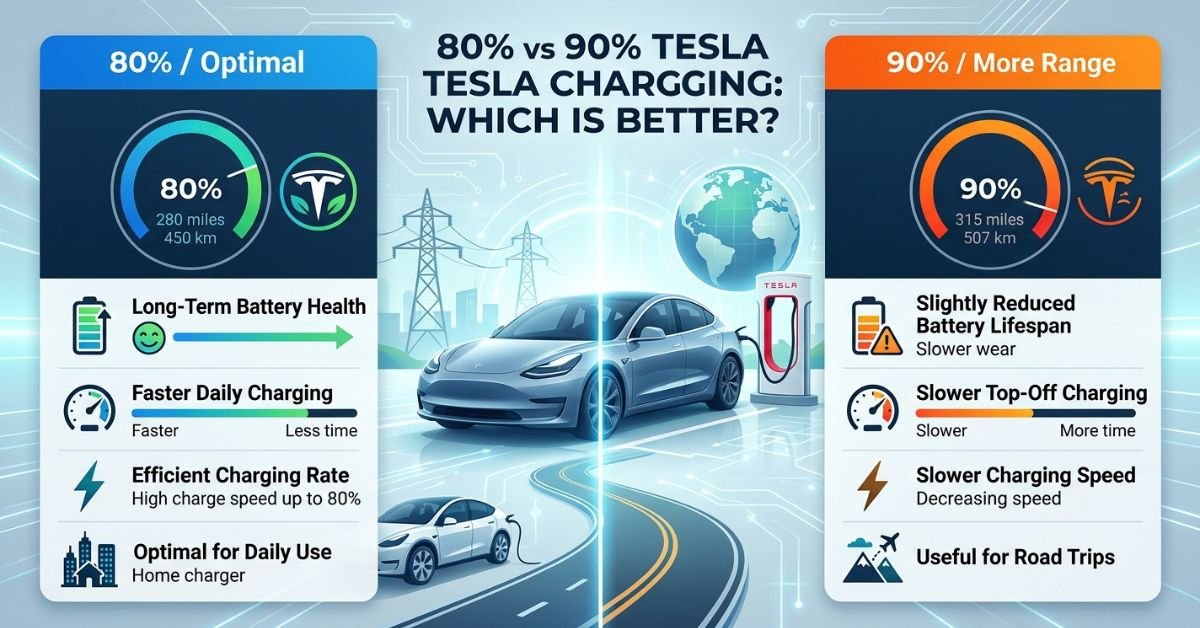
If you are comparing 80% vs 90% Tesla charging, the better setting depends on your battery chemistry, Tesla’s recommended limit for your specific vehicle, and how much range you need each day. For many Tesla owners, 80% is a sensible daily target when the vehicle recommends it. A 90% limit can be useful when you regularly need extra range, but it is not automatically better simply because it gives you more usable energy. Tesla itself says different batteries require different charging routines, and the vehicle touchscreen or Tesla app displays the recommended daily charge limit. This guide explains what the difference means, how it affects battery health and convenience, and when each setting makes sense.
Quick Answer
For a Tesla that recommends 80% for daily charging, 80% is generally the better everyday setting because it leaves a little more buffer below a high state of charge. Choose 90% when your daily driving requires the extra range or your vehicle specifically recommends a higher limit. The most important rule is to follow the battery-specific recommendation shown by your Tesla, rather than applying one percentage to every model.
What Does 80% vs 90% Tesla Charging Actually Mean?

The percentage on your Tesla screen represents the battery’s estimated state of charge, not a universal measurement of how much energy every Tesla stores. Once the vehicle reaches the selected 80% target, charging stops. A 90% limit allows roughly 10 percentage points more usable battery energy before you drive.
That extra 10 percentage points can be meaningful. If your Tesla normally uses 20% during a typical day, an 80% starting point leaves plenty of margin. If your commute, climate, traffic, hills, or highway speed regularly consume much more energy, starting at 90% may reduce charging stops and make the day easier.
However, the difference should not be viewed as a simple rule that 90% is harmful and 80% is safe. Battery aging is influenced by time, temperature, energy throughput, state of charge, charging conditions, and battery chemistry. Tesla therefore gives battery-specific charging guidance rather than one universal percentage.
Why 80% Is Often Better for Daily Driving
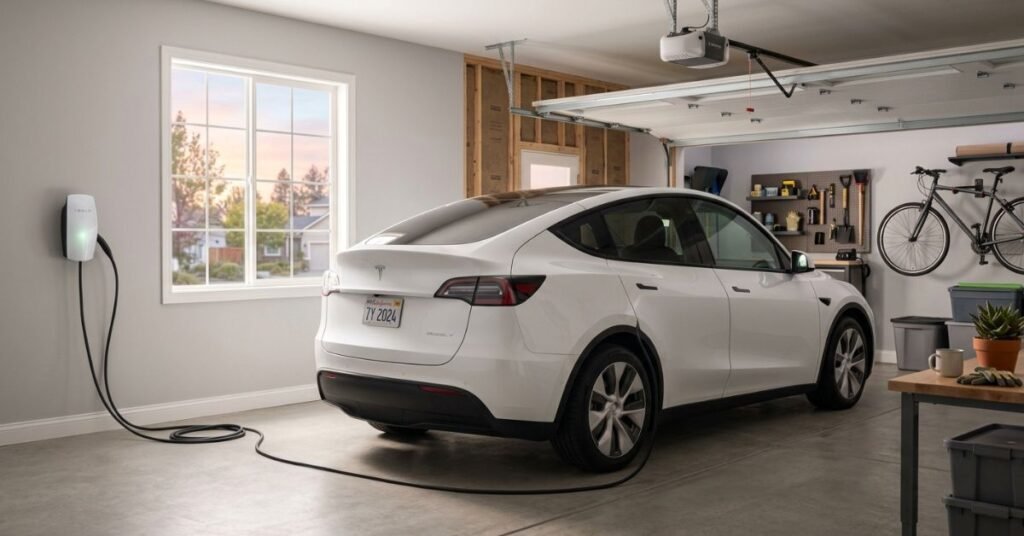
When Tesla recommends an 80% daily limit, following that recommendation is the simplest approach. Tesla’s current range guidance says vehicles with a recommended daily limit of 80% should remain at 80% for daily use, with higher limits reserved for situations that require additional range. Tesla also advises avoiding leaving a vehicle near 0% or 100% for days or weeks at a time.
The practical advantage of 80% is that it provides useful range without routinely keeping the battery at a higher state of charge than necessary. If you plug in at home every night, you can replace the energy you used without waiting for the battery to become very low. Tesla recommends regular charging rather than deliberately waiting for a low state of charge.
For many owners, this creates an easy routine: drive normally, plug in when convenient, and let the car reach its recommended daily limit before the next trip. If your normal driving never needs the additional range, there is little practical reason to choose 90% every day.
When 90% Makes More Sense

A 90% limit can be reasonable when your daily travel is long or unpredictable. Suppose your routine includes a long highway commute, frequent airport trips, remote destinations, or limited charging access. The additional energy can provide a useful reserve and reduce the chance that you need an inconvenient charging stop.
Weather can also change the calculation. Cold temperatures can reduce available range, while high speeds, strong winds, elevation changes, and heavy climate-control use can increase consumption. In those circumstances, a driver who normally manages comfortably at 80% may prefer 90% on particular days.
The key is necessity. If 90% gives you a meaningful convenience benefit, using it can be more practical than obsessing over a fixed percentage. If you only need 90% occasionally, keep a lower daily limit and raise it temporarily when required.
Tesla’s manuals support this flexible approach: charge settings can be adjusted, and the system can allow a temporary increase above the recommended daily limit for a one-time trip.
80% vs 90% for Battery Health
The battery-health question is more nuanced than “80% is good and 90% is bad.” Both are normal operating states, and neither should be treated as a dangerous threshold. The relevant issue is how often the battery remains at a relatively high state of charge and whether that level is necessary for your usage.
If two owners have identical Teslas, but one needs 90% every morning while the other needs only 80%, the second owner is avoiding some unnecessary high-state-of-charge exposure. That does not mean the first owner is damaging the battery by choosing 90%. Tesla’s own guidance emphasizes battery-specific limits and recommends avoiding prolonged periods near full charge.
Battery chemistry matters as well. Tesla has used different battery configurations across models, markets, and production periods, and the recommended charging routine can differ. This is why copying another owner’s percentage from a forum or social-media post is less reliable than checking your own vehicle’s charging screen.
If your Tesla displays 80% as the recommended daily limit, treat that as the primary reference. If it displays a different recommendation, follow the vehicle’s guidance.
Charging Speed and Time

The final part of a charging session can take disproportionately longer than the middle portion because charging power tapers as the battery approaches a high state of charge. At home, this is rarely a concern because the car can charge while parked overnight. On a road trip, however, spending extra time to move from 80% to 90% may be less useful than stopping again later. Your route, charger availability, and required arrival buffer should determine the target. Tesla confirms that charging speed slows as the battery gets fuller.
Battery Chemistry and Tesla Model Differences
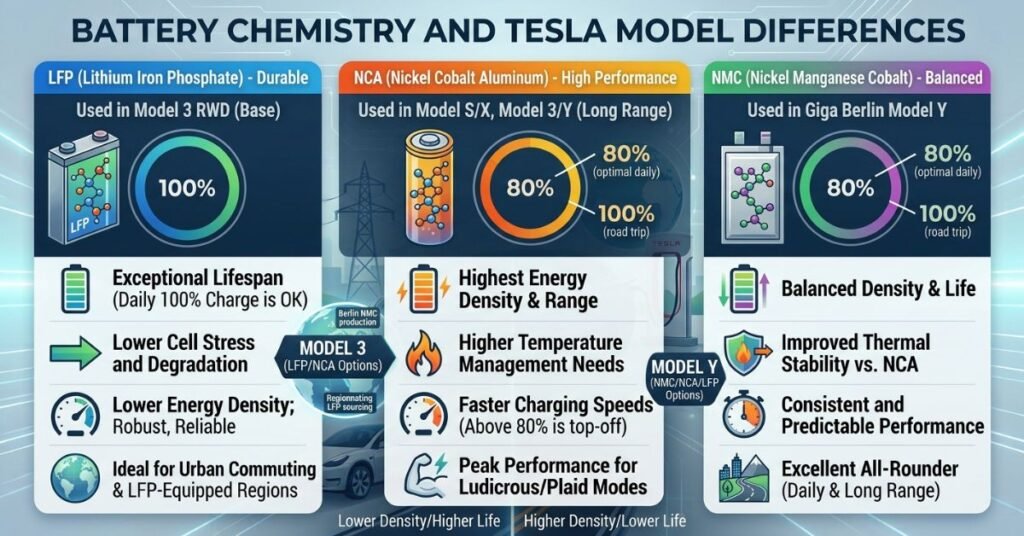
Not every Tesla battery should be managed identically. Tesla’s support documentation explicitly says different batteries require different charging routines for optimal performance. Current and older Tesla vehicles can use different battery chemistries and pack configurations, while recommendations can also vary by vehicle configuration and software.
For that reason, an article that says “every Tesla should always charge to 80%” is too broad. An 80% rule can be appropriate for a Tesla whose screen recommends it, but another vehicle may display a different daily or trip recommendation.
This is especially relevant when buying a used Tesla. Do not assume the charging advice for a newer Model 3 applies exactly to an older Model S, Model X, Model Y, or a vehicle with a different battery configuration. Check the owner’s manual and the charging screen for the specific car.
Does 90% Give You More Range?
Yes. Starting at 90% gives you more stored usable energy than starting at 80%, all else being equal. But it does not mean your Tesla will deliver exactly 10% more real-world driving distance. Range estimates and actual consumption depend on driving conditions, temperature, speed, terrain, traffic, tires, wheels, HVAC use, payload, and battery condition.
The displayed percentage also should not be confused with an official range rating. EPA, WLTP, and other regional testing systems produce standardized figures, while real-world range can differ substantially.
Think of 90% as a larger energy reserve rather than a guaranteed percentage increase in miles or kilometers.
Should You Charge to 90% Every Day?
If your Tesla recommends 80%, charging to 90% every day is usually unnecessary when you do not need the extra range. There is no practical benefit in carrying energy you rarely use, especially when regular high-state-of-charge exposure can be avoided.
But if your daily driving genuinely requires 90%, the convenience may justify it. The goal is not to minimize the percentage at all costs. The goal is to use the battery in a way that fits the vehicle’s recommendation and your real driving needs.
A good rule is simple: use the lowest recommended limit that comfortably covers your normal day. Raise it when your plans require more.
Pros and Cons
80% Pros
- Better fit for vehicles with an 80% recommended daily limit.
- Provides useful daily range without routinely charging as high.
- Leaves room to increase the limit for longer trips.
- Works well with predictable home charging.
80% Cons
- May provide less flexibility for long daily drives.
- Can require an extra charging stop on demanding days.
- Cold weather or high-speed driving can reduce the available range margin.
90% Pros
- Provides more energy at the start of the day.
- Useful for longer commutes and limited charging access.
- Can reduce the need for an additional charging stop.
- Helpful when weather or driving conditions increase consumption.
90% Cons
- May be unnecessary for short daily trips.
- Increases high-state-of-charge exposure compared with 80%.
- Adds charging time, especially as charging power tapers near the upper range.
Who Should Choose 80%?
Choose 80% when your Tesla recommends that limit and your normal driving fits comfortably within the available range. It is particularly sensible for owners who charge at home, drive predictable distances, and can easily raise the limit before a longer trip.
It is also a good default for owners who want a simple battery-care routine without constantly calculating percentages. Set the recommended limit, plug in regularly, and change it only when your plans require more energy.
Who Should Choose 90%?
Choose 90% when the extra range solves a real problem. That might include a long daily commute, limited charging opportunities, frequent highway travel, or seasonal conditions that reduce efficiency.
If you need 90% only occasionally, there is no reason to make it your permanent setting. Tesla’s charging controls make it possible to adjust the limit for individual trips, so your routine can remain at the vehicle’s recommended daily level.
Frequently Asked Questions
Is 80% better than 90% for a Tesla battery?
If your Tesla recommends 80% for daily use, it is the preferred routine. However, 90% is not automatically harmful. Use 90% when the additional range is genuinely useful.
Can I charge my Tesla to 90% every day?
Yes, if your vehicle permits that setting, but whether you should depends on the battery and Tesla’s recommendation. If the car recommends 80%, there is usually little reason to use 90% when you do not need the extra range.
Is 90% better for long trips?
It can be useful, but the best trip target depends on the route. Tesla navigation can recommend the charge needed for the next Supercharger. More energy is not always faster if it means spending longer at the charger.
Should I charge to 100% instead?
Use 100% when your vehicle’s guidance and trip requirements make it appropriate. Tesla recommends avoiding leaving vehicles near 100% for extended periods and says vehicles with an 80% daily recommendation should generally use 100% when necessary, such as before a long trip.
Does 80% charging extend Tesla battery life?
Following Tesla’s recommended daily limit can help reduce unnecessary battery stress and supports the company’s battery-care guidance. Battery aging still occurs naturally over time and use.
What if my Tesla recommends 90%?
Follow the recommendation shown for your vehicle. Tesla says charging routines vary by battery, so your car’s displayed guidance is more relevant than a generic online rule.
Is 80% or 90% better for Supercharging?
For road trips, neither percentage is universally best. Charge enough for the next leg with a sensible buffer. Charging slows as the battery becomes fuller, so unnecessarily high targets can add waiting time.
Conclusion
The real answer to 80% vs 90% Tesla charging is not that one percentage is universally correct. If your Tesla recommends 80% for daily use, make 80% your normal setting and increase it when you need more range. If your vehicle recommends a different limit, follow that battery-specific guidance.
For daily driving, 80% is often the efficient,low-maintenance choice. For longer commutes, difficult weather, or limited charging access, 90% can provide valuable flexibility. The smartest approach is to match the charge limit to your vehicle and your actual driving needs rather than following a one-size-fits-all rule.
{ “@context”: “https://revtesla.com”, “@graph”: [ { “@type”: “Article”, “@id”: “https://revtesla.com/#website”, “url”: “https://revtesla.com/”, “name”: “RevTesla”, “description”: “Your trusted source for Tesla guides, battery analytics, and EV technical insights.”, “publisher”: { “@id”: “https://revtesla.com/#organization” } }, { “@type”: “Organization”, “@id”: “https://revtesla.com/#organization”, “name”: “RevTesla”, “url”: “https://revtesla.com/”, “logo”: { “@type”: “ImageObject”, “@id”: “https://revtesla.com/#logo”, “url”: “https://lh3.googleusercontent.com/pw/AP1GczOZMYbm6vY4sp2fsW-bWnF64lVo6X0hBo4UUzzOzuI5FGoptrIKNf4wMwsOXhnJZpcbuuCpoL6cSK3ErMNVuiRtktuBp0KJGemjwCdPWRLVBVdDYZk=w1920-h1080-rw-nu-e365”, “caption”: “RevTesla Logo” } }, { “@type”: “Person”, “@id”: “https://revtesla.com/#author-tom”, “name”: “Tom”, “jobTitle”: “Automotive Technical Writer & EV Analyst”, “worksFor”: { “@id”: “https://revtesla.com/#organization” } }, { “@type”: “TechArticle”, “@id”: “https://revtesla.com/80-vs-90-tesla-charging/#article”, “isPartOf”: { “@type”: “WebPage”, “@id”: “https://revtesla.com/80-vs-90-tesla-charging/” }, “headline”: “80% vs 90% Tesla Charging: Which Is Better?”, “description”: “A comprehensive technical comparison evaluating 80% vs 90% Tesla daily charging limits, impact on battery health, charging taper speeds, and chemistry recommendations.”, “url”: “https://revtesla.com/80-vs-90-tesla-charging/”, “mainEntityOfPage”: “https://revtesla.com/80-vs-90-tesla-charging/”, “inLanguage”: “en-US”, “author”: { “@id”: “https://revtesla.com/#author-tom” }, “publisher”: { “@id”: “https://revtesla.com/#organization” }, “image”: [ “https://lh3.googleusercontent.com/pw/AP1GczOZMYbm6vY4sp2fsW-bWnF64lVo6X0hBo4UUzzOzuI5FGoptrIKNf4wMwsOXhnJZpcbuuCpoL6cSK3ErMNVuiRtktuBp0KJGemjwCdPWRLVBVdDYZk=w1920-h1080-rw-nu-e365”, “https://lh3.googleusercontent.com/pw/AP1GczPzPdV4HBZSUZ_Zk1jiNY1lFASG7PvQX0shRK0-FMWMaKOkl4aiiKOXvgxe8k2JdJ1GcWLG9-mXDgpCNJUTw264p5Db_OtqppYRWuUoiIlaPLCAPaY=w1920-h1080-rw-nu-e365”, “https://lh3.googleusercontent.com/pw/AP1GczPwzLaLI1FWfd8_Nsna85Jp5QL1AvkZOPYweIq4JYKZZwoQqnDRx8Msedqw_xlbHrOiYjxZhRYOsK1EYx4_uxe0P2PzfMlumBJaW1JHJ6aN7YtppcY=w1920-h1080-rw-nu-e365”, “https://lh3.googleusercontent.com/pw/AP1GczN856oOGrOLMUnK7192QtXQA1CtPe8pHZO528RZlskNhi8H8Jimooqk5A9sqhemE2o2v6d9kZVzMv0QkITslFPMkx9lCce_nD-H8Ua6Yse5FMusE7M=w1920-h1080-rw-nu-e365”, “https://lh3.googleusercontent.com/pw/AP1GczOzvTnQLNpRw4THxlGeF2ZkwBokZ1TJtNnFt5tMihQqws4yDZPOpYNzD3JialXDwAEtL4Q9tcv1wC1CFA79TT4HtvZQBIjfBQPoXTTO4N-Ykv-WvpE=w1920-h1080-rw-nu-e365”, “https://lh3.googleusercontent.com/pw/AP1GczO9ptnQoCflUbvOBOllybU07PPsiGl-s_aNpKz71ZAxGLOoS2QGGlrc8VUyeQ5191v07j0B0FM2D267_FGcGV73vZIYDAqc8FVMHaUqLBdmsY92Ygw=w1920-h1080-rw-nu-e365”, “https://lh3.googleusercontent.com/pw/AP1GczOG7y_NkbXCeTW6Oe58gqsJv9jmklPbHHZx1wPb4O7Q-JWRh5rTnFzlEIfe7Z25p9lPMhgrLWA0A2JjxbZYROIF69NfB3fG3QMnRcQgLDuY-2KZDhk=w1920-h1080-rw-nu-e365”, “https://lh3.googleusercontent.com/pw/AP1GczP8g9aWw4F5glITdm1upocbfLtd5-SziqV9EZtcx8ehWz_pNOxQeCcQjYO_AFJUwhDkLub9rcA43cZs3mgdgcOpaqlPE0NqzHU9Hx935XGl0A7DYeY=w1920-h1080-rw-nu-e365”, “https://lh3.googleusercontent.com/pw/AP1GczOHyt9_UqzrE0Z96z16Kd6tHsEQ8vWh9S3HbFW0m-8yWcLjWFyo57tPHvbL88_xg7bpv29UQbvVN1pET9G1u5X-ky_w3Yvde3QUP-9jnhf_lbnkFwE=w1920-h1080-rw-nu-e365”, “https://lh3.googleusercontent.com/pw/AP1GczOTh9PTwg0k3hvtm2Ws-MNJW0wDRjuLzgYSGpV6TxrU1fQGVDHUdkf_I0-ppino6rA5BspVUu4v_bO3D19pOuELOF6szVXWaGBT99-FIPoA0fKmIhQ=w1920-h1080-rw-nu-e365”, “https://lh3.googleusercontent.com/pw/AP1GczMGntRV-PNQq6TVbVU_jH0x9I1yUPUmPWKT3z2m0Yh1b-zH30GKspv90GLeP8UKZM3Llr00RXiquPz_BAzoRRYjzLdRyT4eHVjp68OUVpKevWY50sI=w1920-h1080-rw-nu-e365”, “https://lh3.googleusercontent.com/pw/AP1GczNPjS_9FYo6dA2BXnrdNjHAsSnQHRHz1MsFDaAGqvjV_boCcrjuZ-o3a1v6rvSFYTt9_dlOFHgpYCrYTEJ9dLTHfkPacCwG6mRUW9lzSsnixNkDX88=w1920-h1080-rw-nu-e365”, “https://lh3.googleusercontent.com/pw/AP1GczMh_p884J-xwuhcrxAAdN2zYhGBiKfuG7phfHoGvqNR9PINZYXsyFhKhhFxHWrC4m4r3Ro-iw-2cDCkE2fVoP9wy-w9rFj_Nc39T2oHrH9ZukNDaGM=w1920-h1080-rw-nu-e365” ] }, { “@type”: “FAQPage”, “@id”: “https://revtesla.com/80-vs-90-tesla-charging/#faq”, “mainEntity”: [ { “@type”: “Question”, “name”: “Is 80% better than 90% for a Tesla battery?”, “acceptedAnswer”: { “@type”: “Answer”, “text”: “If your Tesla recommends 80% for daily use, it is the preferred routine. However, 90% is not automatically harmful. Use 90% when the additional range is genuinely useful.” } }, { “@type”: “Question”, “name”: “Can I charge my Tesla to 90% every day?”, “acceptedAnswer”: { “@type”: “Answer”, “text”: “Yes, if your vehicle permits that setting, but whether you should depends on the battery and Tesla’s recommendation. If the car recommends 80%, there is usually little reason to use 90% when you do not need the extra range.” } }, { “@type”: “Question”, “name”: “Is 90% better for long trips?”, “acceptedAnswer”: { “@type”: “Answer”, “text”: “It can be useful, but the best trip target depends on the route. Tesla navigation can recommend the charge needed for the next Supercharger. More energy is not always faster if it means spending longer at the charger.” } }, { “@type”: “Question”, “name”: “Should I charge to 100% instead?”, “acceptedAnswer”: { “@type”: “Answer”, “text”: “Use 100% when your vehicle’s guidance and trip requirements make it appropriate. Tesla recommends avoiding leaving vehicles near 100% for extended periods and says vehicles with an 80% daily recommendation should generally use 100% when necessary, such as before a long trip.” } }, { “@type”: “Question”, “name”: “Does 80% charging extend Tesla battery life?”, “acceptedAnswer”: { “@type”: “Answer”, “text”: “Following Tesla’s recommended daily limit can help reduce unnecessary battery stress and supports the company’s battery-care guidance. Battery aging still occurs naturally over time and use.” } }, { “@type”: “Question”, “name”: “What if my Tesla recommends 90%?”, “acceptedAnswer”: { “@type”: “Answer”, “text”: “Follow the recommendation shown for your vehicle. Tesla says charging routines vary by battery, so your car’s displayed guidance is more relevant than a generic online rule.” } }, { “@type”: “Question”, “name”: “Is 80% or 90% better for Supercharging?”, “acceptedAnswer”: { “@type”: “Answer”, “text”: “For road trips, neither percentage is universally best. Charge enough for the next leg with a sensible buffer. Charging slows as the battery becomes fuller, so unnecessarily high targets can add waiting time.” } } ] } ] }