
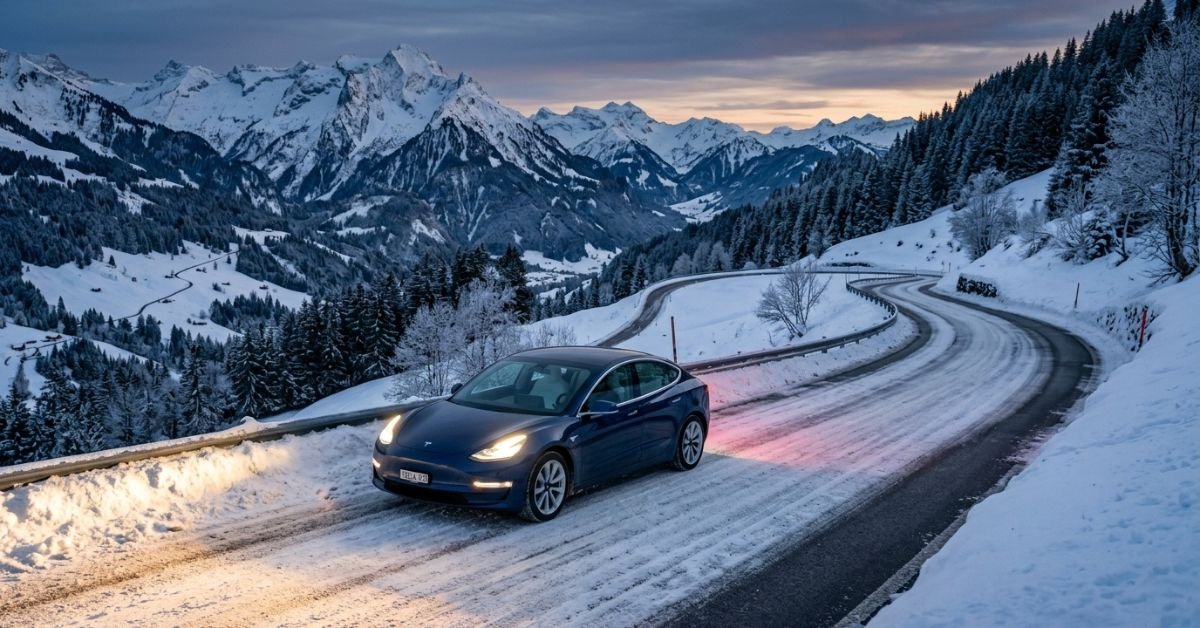
Every vehicle responds differently to winter driving and an EV has a few additional factors. Winter driving requires many considerations. tires, battery prep, charging, visibility, traction, cabin heating, and trip planning.. When fully prepared and driven correctly, Tesla cars are well-suited to winter driving. The cold temperatures can affect performance and make driving on winter roads more challenging.
The most basic rule is to get the car ready before you depart, make sure the tires are right for the weather, drive smoothly and leave extra time and energy in the margin. These features and menus may be different on the various Tesla models and model years, software versions and markets, so please consult your current Owner’s Manual for instructions specific to your model..
Quick Answer
The key tips to Tesla winter driving are having the right winter or all-season tires, checking tire pressure in cold weather, pre-conditioning battery and cabin when plugged in, clearing snow and ice, and expecting to see a lower real-world range, plan a charging stop conservatively, and drive gently on snow or ice. Tesla advises winter tyres for cold weather or snowy, icy roads
Why Winter Changes Tesla Driving
The battery and the tires are both impacted by cold weather. A cold, high-voltage battery may not be able to supply the energy as efficiently until it is heated, and heating the cabin requires extra electricity. Other factors that may contribute to higher energy consumption include snow, slush, standing water, wind, and reduced temperatures.
Tires are also crucial. They become less flexible in cold weather, which can make them less grippy. Performance summer tyres have lower grip in icy conditions and below 5°C and are not suitable for snow or ice, claims Tesla. While all-season tyres can be used in a variety of situations, they are not necessarily as effective in snow or icy conditions as winter tyres.
That is, a Tesla’s advanced traction control, all-wheel drive, or software systems will not help it when it is equipped with tires that are ill suited for the conditions or the road. The points of vehicle and road contact remain important..
Choose the Right Tires
The first priority in the winter is tire selection. In regions where it snows, ices, or stays freezing for extended periods of time, it might be best to use winter tires. It is better to have a full set of four winter tyres than to mix different seasons, says Tesla. The mountain and snowflake symbol on the tire’s sidewall indicates a winter tire.
All-season tyres may be acceptable in areas with mostly cool, wet winters and light snowfalls. But their performance is dependent on the tire design, temperature, road surfaces and the local climatic conditions. It is better to check the manufacturer’s data and winter specifications than to assume that all-season tires are the same.
Check Tire Pressure When Cold
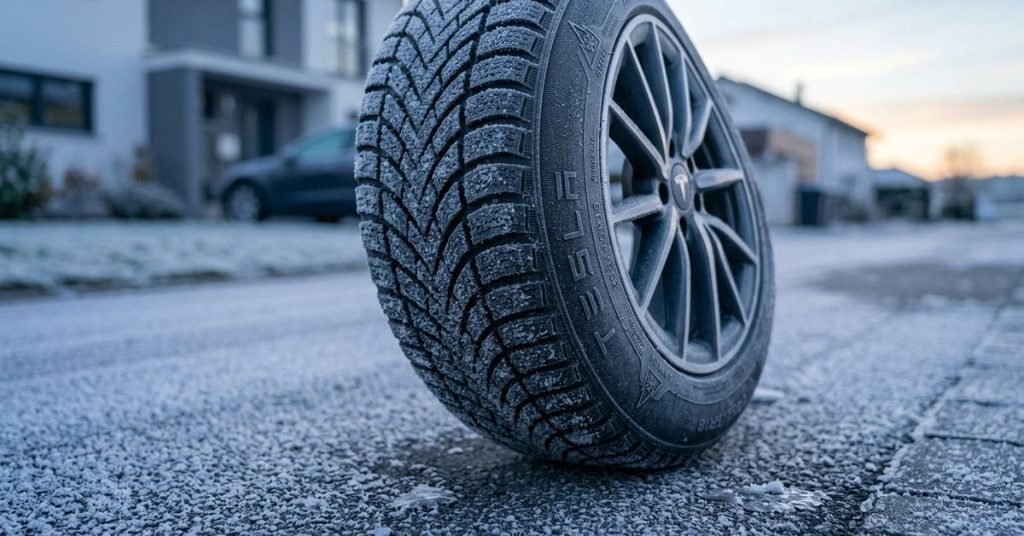
Cold weather can cause tires to lower and raise their pressure. Low tire pressure will affect your handling, rolling resistance, and can make for quicker tread wear. Tesla recommends checking pressure when tires are cold and with the specified pressure on the tire and loading information label (not by using the number molded into the tire sidewall).
Throughout the winter, check the pressure before extended trips or large swings in temperature.Check tread pattern and for cuts, bulges, or uneven wear.
Don’t deflate air from a hot tire only to find the pressure is briefly too high. Make comparisons of readings with the same conditions, as possible.
Precondition Before You Drive
Pre-conditioning is one of the most convenient features of the Tesla in cold weather. Can pre-heat the cabin and battery before you leave, meaning you start off with a more comfortable cabin and a battery ready for driving/charging.
Precondition if possible whilst the vehicle is connected to the power. Tesla describes the preconditioning function as one that warms the car’s battery and cabin and, when the power is turned on, prevents loss of stored energy for the trip. Vehicle scheduling or Tesla app can be used for preconditioning, but the controls differ depending on configuration and software.
Have the car ready near your departure time on a cold morning. When an emergency requires an unexpected departure, use the Tesla app’s climate controls, if available. Defrost clears frost, snow and ice from supported vehicles.
Do not force frozen parts, give them some time to thaw or freeze and check with your model’s Owner’s Manual.
Winter Range is expected to be reduced.
Never schedule a winter trip based on your range expectation, which is typical of mild weather.Never schedule a winter trip based on your range expectation, which is typical of mild weather. Real-world efficiency can be further diminished by cabin heating, wet or snowy roads, cold temperatures, the rolling resistance of various parts, and the additional energy requirement.
Consider things beyond just one number, such as the route, elevation, weather forecast, traffic, and charging stations, as well as battery life..
Leaving a big charging buffer is a good winter practice. If the station is full, the weather deteriorates or the energy demand is greater than anticipated, charging will provide more options if it occurs earlier in the day.
Plan Charging More Conservatively
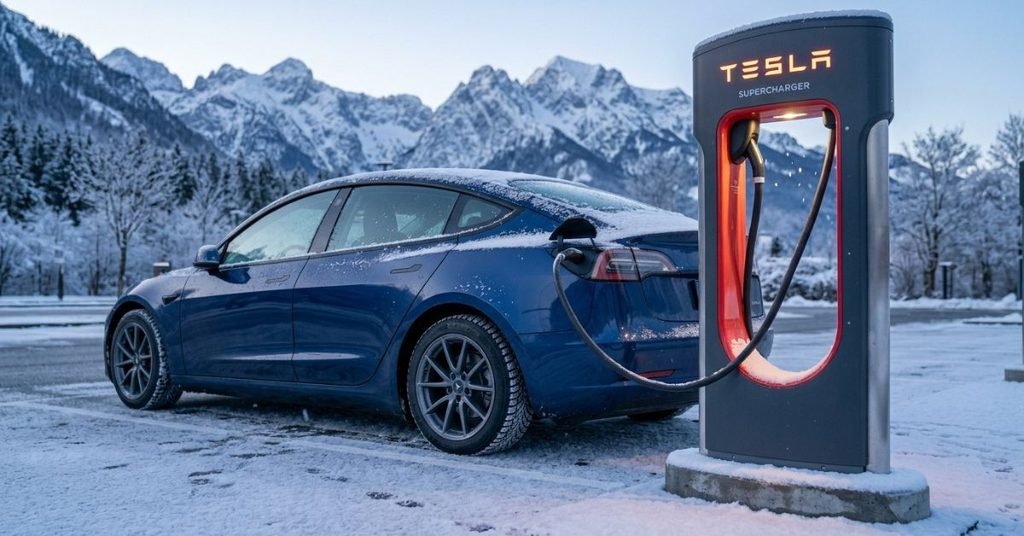
Cold batteries can charge differently to warm batteries. Battery preconditioning prior to charging stop may prepare the battery for charging, especially in cold conditions. Tesla currently recommends preconditioning the battery prior to low-temperature driving and, if possible, preconditioning while the car is plugged in.
In the event that you are going on road trips, include charging stations in your route plan and find other stops if they are missing. Some markets may only be compatible with certain connectors, and adapters may be needed.
When charging with a very cold battery, the charging rate may be slower initially while the battery is warming up. It may not necessarily be a problem.
Clear Snow and Ice Completely
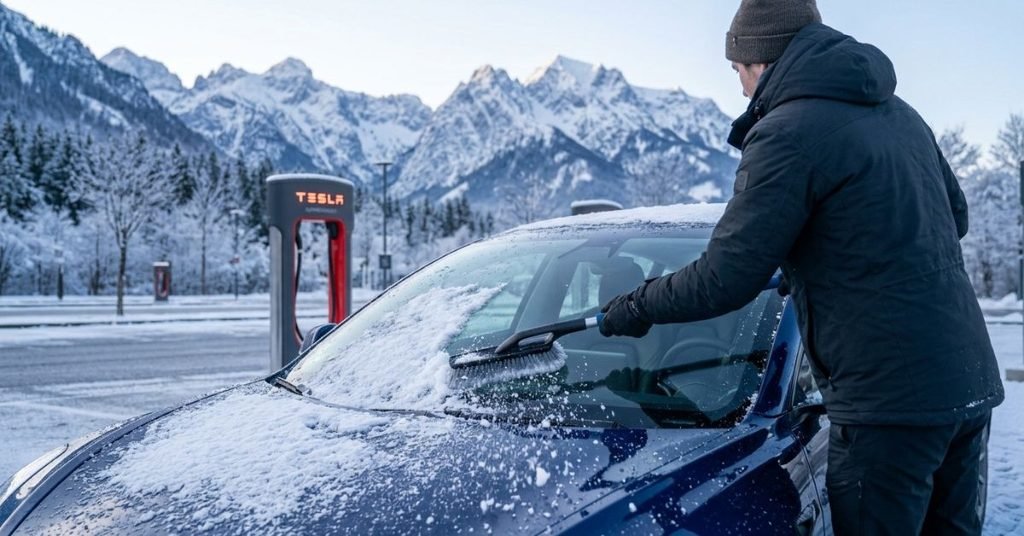
Do not assume that a small area of glass is enough to see through. Clear snow and ice off of windshield, side windows, mirrors, lights, cameras and other parts of the vehicle that are required for safe operation.
When the vehicle is in motion, it may become a hazard because of the heavy snow on the roof. It can slide forward and hit the windshield or it can blow onto other road users. Before driving, shovel snow off the road.
Frozen door handles, windows, mirrors and wipers may also need special attention. Tesla’s winter driving information suggests using cabin climate and defrost to help warm up the car and defrost or remove ice.Do not force frozen parts, give them time to heat and defrost; follow the instructions in your model’s Owner’s Manual..
Drive Smoothly on Snow and Ice
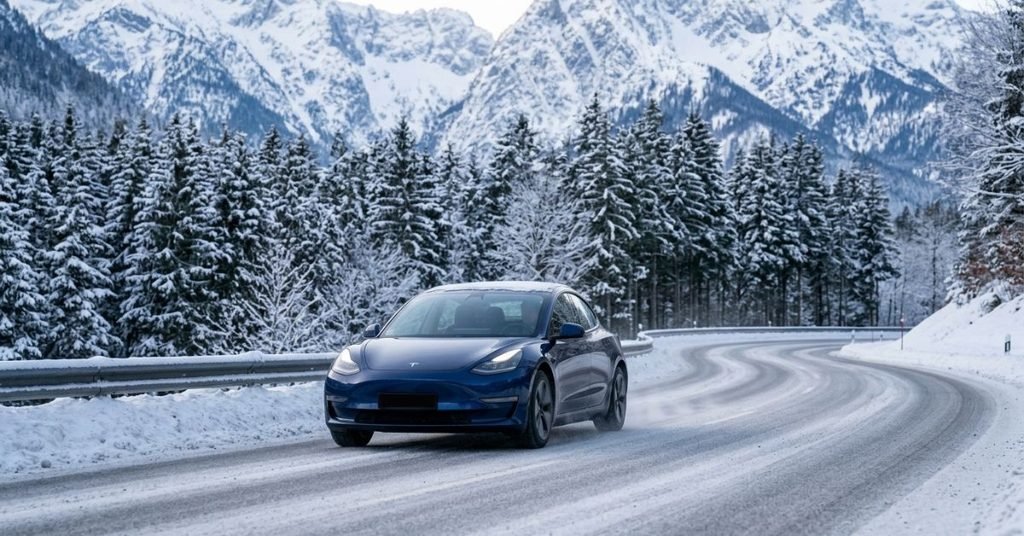
While electronic traction systems are useful in controlling wheel slip, they don’t break the laws of physics. Drive slowly when accelerating, slow down sooner, steer carefully, and avoid cutting too many corners when driving in wet conditions.
Maintain greater distance behind than on dry pavement. When there is snow and ice, stopping distances are longer and slush can cause grip to change suddenly. Slow down when approaching curves and hills, intersections and places where road conditions may vary.
For vehicles with selectable acceleration and/or driving modes, select the correct mode based on conditions and model. Do not think that a stronger setting will work better on a slippery surface.
The feeling of regenerative braking may also vary depending on the weather and some winter tyres. Aggressive winter tyres compounds and tread patterns can also temporarily diminish the regenerative braking power while the system is recalibrating, Tesla writes
Take care of Regenerative Braking
While one-pedal driving can be helpful in winter, it’s something you should be mindful of. Deceleration on slippery tires can be different than on dry roads. Before using regenerative deceleration on a slippery road, get to know your Tesla.
If regenerative braking is temporarily limited due to the battery being cold, the vehicle may not decelerate in the same manner as it would when the battery is warm. Adapt your driving style to the driver’s display. The best way is to be prepared.The best way is to be prepared. Decelerate prior to the curve, maintain a greater distance between vehicles and apply the brake pedal gradually as needed. .
Use the Right Snow Chains
In some extreme cases, snow chains can be helpful to improve the grip, but they do not work with all Tesla wheel and tire combinations.For specific models, tires, and configurations, Tesla provides approved chain specifications. The set-up can be different, always check the approved setup, do not trust physically okay set-up is safe to use.
Please read the current Owner’s Manual before buying or installing chains. Tesla also cautions against using chains on configurations that are not approved for use and some wheel types or covers may need special procedures.
Keep Visibility and Wiper Function and optimum levels.
The winter driving season is often accompanied by dirty glass, freezing rain, salt, and road spray. Change out worn wiper blades before it gets really cold and use washer fluid appropriate for your local freezing temperatures.
Ensure headlights, taillights, mirrors and cameras are clear. Reduced visibility or driver assistance functions can be affected by snow and dirt on the road surface. If the camera or sensor is blocked, do not assume the camera or sensor will function as usual.
Driver assistance systems are no substitute for winter driving. The availability and behavior of these may differ with the model, hardware, software and region. Maintain hands, attention and judgment as per Tesla and local law.
Get ready for a Winter Road Trip
If you are making a long haul winter drive don’t just look at the percentage of battery life. Assess weather forecasts, road conditions, tire condition, alternate routes, and charging stations.
Useful items to have around for the winter:
- Charge before starting out, but precondition if necessary..
- Check cold tire pressures.
- Check for appropriate tires and treads.
- Remove all snow and ice.
- Take winter emergency gear.
- Be aware of other means of charging.
- Plan for additional travel time.
For remote locations, think about the needs of the area including warm clothing, water, food, a phone charger and equipment necessary for regional authorities. Emergency needs are country specific and follow local advice.
These tips will be most useful to whom?
These practices are most important for drivers who work in conditions where the weather is cold enough to freeze, snowy, icy, mountainous, or long winter travels. They’ll also be helpful for anyone that travels to a colder region with a Tesla car that runs fine in warmer climates.
Tesla isn’t the key to the right preparation, it is the conditions that matter. The different rear-wheel-drive options paired with winter tires and the all-wheel-drive option with all-season tires require different winter set-ups, and even with those, careful driving is required.
The right preparation depends on the conditions rather than the Tesla badge. A rear-wheel-drive Tesla with appropriate winter tires can have a different winter setup from an all-wheel-drive model on all-season tires, and neither configuration removes the need for careful driving.
Conclusion
Tesla winter driving starts well before the car moves. Suitable tires, correct pressure, preconditioning, complete snow and ice removal, conservative charging plans, and smoother driving inputs can make cold-weather travel more predictable.
The key is to plan around conditions instead of relying on the vehicle’s maximum capabilities. Give yourself extra energy and stopping margins, verify your equipment, and use Tesla’s model-specific guidance. With that approach winter becomes a condition to prepare for rather than a reason to overlook basic EV and road-safety principles. A little preparation also reduces stress when weather changes unexpectedly, because you have already checked the tires, battery, route, visibility, charging options, and emergency supplies before setting off during routine winter travel too especially.
Frequently Asked Questions
Does the cold weather impact the range of a Tesla?
Yes. Real-world efficiencies are diminished by cold temperatures and cabin heaters, battery warmers, wind, wet roads, snow and speed increase energy usage. This varies depending on conditions and vehicle.
Should you pre-condition your Tesla in winter?
It is useful due to the preconditioning which can warm up the cabin and battery before take-off. If possible, this should be done when the car is connected to the battery, to minimize energy consumed from the battery for initial heating.
Do Tesla’s need winter tires?
They are very relevant in cases where snow and ice occur. The best tires for winter weather or roads that might encounter snow and ice depend on the climate, the type of tires, and the regulations. Tesla recommends winter tyres for cold weather or tires that might be used on roads where snow or ice may be present.
Is it possible to drive a Tesla vehicle in snow?
Yes, as long as the vehicle is equipped with suitable tyres and the road is safe to drive on. Snow can significantly decrease traction, so vehicle capability is not an excuse to drive faster than circumstances permit.
Does regenerative braking work in cold weather?
It may be temporarily disabled if the battery is cold and after some tire changes. Driver should watch for increased stopping distance due to the possibility of the vehicle adjusting the regenerative braking as conditions change, and drive smoothly.