Life Span of a Tesla Battery: Tesla Battery Health (200,000 Miles Later) 2026 Data & Replacement Costs
Editor’s Note: Battery degradation remains the number one concern for used EV buyers. This comprehensive guide synthesizes real-world 2026 fleet data to separate myth from reality. The findings reveal that modern EV battery packs specifically Tesla’s are easily outlasting the traditional lifespan of internal combustion engines. This is a must-read benchmark for anyone looking to buy, sell, or maintain a high-mileage electric vehicle.
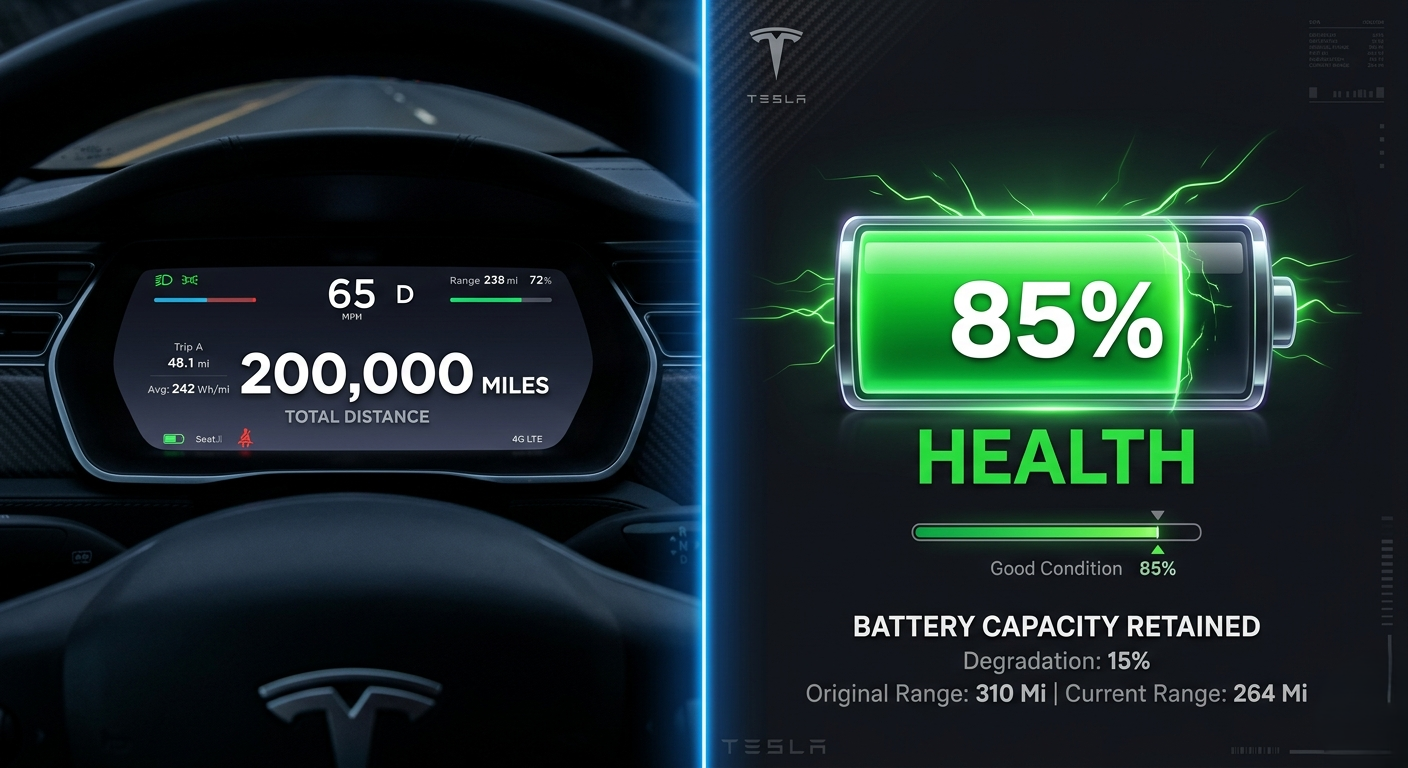
Quick Answer Tesla battery health (200,000 miles later) shows an average of just 12-15% capacity loss, meaning 85%+ health is still retained. Batteries do not die suddenly. LFP packs (Standard Range) degrade 30% less than NMC packs. Replacement costs range from $10,000-$15,500, but if your battery health stays above 80%, no replacement is needed. Life Span of a Tesla Battery
If you are wondering what Tesla battery health (200,000 miles later) actually looks like you are not alone. It is the most common concern among used Tesla buyers and high-mileage owners. But 2026 fleet data tells a clear story: Tesla batteries age significantly better than gasoline engines. In this guide, we cover real numbers, at-home tests, replacement costs, and the hidden factors most competitors miss so you can make a fully informed decision.
Tesla Battery Health (200,000 Miles Later): What Does the Real Data Say?
We are no longer guessing. 2026 fleet data from Recurrent Auto and Tesla Impact Reports provides years of solid evidence. Here is what Tesla battery health at 200,000 miles actually looks like:
- Model 3 and Model Y Long Range packs average just 12-15% capacity loss at 200,000 miles.
- That means 85%+ battery health is still retained far better than a gasoline engine at the same mileage.
- LFP (Standard Range) packs degrade 30% less than NMC packs backed by 5 years of solid data.
Tesla Battery Degradation Calculator: Check Your Health at Home

Formula: (Current Full Charge Range / Original EPA Range) x 100 = Battery Health %
Example: Model 3 Long Range Original EPA range 358 miles, now showing 310 miles at 100% charge:
(310 / 358) x 100 = 86.6% Excellent Health
Always note the range immediately after a 100% charge. Tesla battery health (200,000 miles) is most accurately measured this way partial charges produce misleading readings.
Why Battery Chemistry Matters: LFP vs NCA/NMC

LFP (Lithium Iron Phosphate) Standard Range Models
- 100% daily charging is completely safe Tesla officially recommends it for LFP.
- Degrades 30% less than NMC over the long term the clear 2026 winner for longevity.
- Lower calendar aging compared to NMC chemistry.
NMC/NCA (Nickel Manganese Cobalt / Nickel Cobalt Aluminum) Long Range Models
- Keep daily charging at 80% reserve 100% for long trips only.
- More sensitive to frequent Supercharging compared to LFP chemistry.
2026 data makes it clear: Tesla battery health (200,000 miles later) is significantly better for Standard Range (LFP) owners who follow smart charging habits.
Essential Factors Affecting Tesla Battery Longevity and Degradation

Extreme thermal stress, particularly in climates like Phoenix or Dubai, remains the primary catalyst for Tesla battery degradation. . High temperatures accelerate chemical reactions inside cells, causing permanent capacity loss. If you live in a hot climate:
- Always park in a garage or shaded area when possible.
- Avoid charging in direct sunlight.
- Use the Preconditioning feature before charging or driving to stabilize cell temperature.
Cold weather tells a different story. It causes only temporary range reduction not permanent damage. Once temperatures normalize, range returns. This is why Tesla battery health (200,000 miles later) tends to hold up better in cold climates than in hot ones. Life Span of a Tesla Battery
2. Charging Habits: How Much Should You Charge?
- LFP battery: 100% daily charging is fine Tesla recommends it for this chemistry.
- NMC/NCA battery: Limit daily charging to 80%. Charge to 100% only before long trips.
- Never let the battery drop to 0% deep discharge causes long-term cell damage.
- Prefer regular AC (Level 2) charging over DC fast charging whenever possible.
3. Supercharging Guilt: Did You Damage Your Pack?

“I have Supercharged 90% of the time is my pack ruined?” The data says: No. Heavy Supercharging causes only 1-2% additional degradation. Across Tesla battery health (200,000 miles later), this is practically negligible and is not a reason for concern.
4. Vampire Drain: The Hidden Battery Killer

Here is what most competitors miss: Sentry Mode and background apps likely consumed 5,000 to 8,000 kWh over 200,000 miles significantly accelerating calendar aging. The solution is simple: use Sentry Mode only when necessary and avoid leaving the car idle and plugged in indefinitely.Life Span of a Tesla Battery
5. BMS Calibration vs. Physical Degradation: Try This First

Range loss is often caused by BMS (Battery Management System) confusion, not actual battery degradation. To reset: drain the battery to 10-15%, then charge to 100% on a Level 2 charger without interruption. This recalibrates the BMS and frequently restores accurate range readings.
Service Mode Battery Health Test: Now Anyone Can Run It

A significant 2026 update: every Tesla owner can now run a Battery Health Test directly from the car menu. Previously, only Tesla service technicians had access to this test.
- Battery must be at 20% or below before starting.
- Car must remain connected to a Level 2 AC charger for 24 hours.
- Do not interrupt the test once it has begun.
The result is an accurate State of Health (SoH) percentage showing exactly how much original capacity remains in the pack. This is the most reliable method to measure Tesla battery health (200,000 miles later) at home.
Tesla Battery Replacement Costs: Updated 2026 Pricing

If Tesla battery health (200,000 miles later) drops below a usable threshold and replacement becomes necessary, here are the real 2026 costs:
Official Tesla Replacement (Out of Warranty, Fully Installed)
- Model 3 / Model Y: $10,000 to $15,500
- Model S / Model X (Legacy packs): $18,000 to $22,000
Third-Party Repair (Failed Modules Only)
- $3,000 to $7,000 only the failed modules are replaced, not the entire battery pack.
- Specialized EV repair shops offer this service; Tesla authorized service centers do not.
Key point: if Tesla battery health (200,000 miles later) remains above 80%, replacement is not required. These vehicles are completely road-worthy and continue to perform reliably.
Hardware 3 vs. Hardware 4: The Thermal Management Difference

- HW4 features significantly improved thermal management keeps battery cells at a more consistent temperature.
- HW3 uses an older cooling architecture that creates slightly more cell stress in extreme temperatures.
- Long-term, HW4 vehicles are expected to show better Tesla battery health retention.
- This difference is worth factoring in when evaluating the resale value of older HW3 vehicles.
Buying a Used Tesla: What to Check for Battery Health
Properly evaluating Tesla battery health (200,000 miles later) on a used car comes down to four key steps:
Step 1: Review the Service Records
Access the full service history through the seller’s Tesla account. Any battery replacement or major issue will be documented here.
Step 2: Run the 100% Charge Test
Ask the seller to charge the car to 100% and show the displayed range. Apply the formula above to calculate the current battery health on the spot.
Step 3: Request Professional Reports
- Tessie App Report: Provides detailed battery analytics and historical usage data.
- Recurrent Report: Benchmarks the battery against fleet data a highly trusted resource for used EV buyers.
Step 4: Review the Charging History
If the car was charged almost exclusively via DC fast charging (Supercharging) with little to no Level 2 home charging, treat this as a minor caution flag particularly for LFP-based models. On resale value: a Tesla at 200,000 miles with Tesla battery health (200,000 miles later) above 80% can still command a fair market price. The used EV market for well-maintained high-mileage Tesla is real, growing, and more informed than ever.
Environmental Impact: The Battery Recycling Economic Angle
- Tesla’s Gigafactory runs an active in-house battery recycling program.
- Retired EV packs find a second life in stationary energy storage systems.
- Recycling value provides a material floor for resale price buyers understand the pack retains recoverable value.
These factors make the overall picture of Tesla battery health (200,000 miles later) even more favorable. A high-mileage Tesla battery is not simply a worn-out component it is a recoverable resource with ongoing value.
Bottom Line: What Tesla Battery Health (200,000 Miles Later) Means for You
Tesla battery health (200,000 miles later) is not the scary scenario most people expect. With an average of 85%+ capacity still retained, the vehicle remains completely usable and is in far better shape than a comparable gasoline engine at the same mileage.
Key takeaways:
- Degradation is gradual and linear sudden battery death is a myth.
- LFP packs are the clear longevity winner in 2026.
- Above 80% health, no replacement is needed.
- The Service Mode Battery Test now allows owners to check health at home for free.
- Third-party module repair can reduce replacement costs to as low as $3,000 to $7,000.
Whether you are a high-mileage daily commuter, a budget-conscious used EV buyer, or simply curious about your current car the evidence on Tesla battery health (200,000 miles later) is genuinely encouraging. These batteries are engineered for the long haul, and 2026 data confirms it. Start with the Service Mode Battery Test and the Degradation Calculator in this guide your Tesla battery health may surprise you.
Latest Update:
- Tesla App Integration: In addition to the 24-hour Service Mode test, Tesla’s recent 2026 software updates now allow owners to view basic battery health metrics and quick scans directly inside the official Tesla Mobile App under the “Service” menu.
- Recurrent Auto & Tesla Impact Data: The latest 2026 fleet statistics confirm that degradation follows a non-linear S-curve. The initial 3-5% drop happens early, followed by a long, flat plateau where packs retain 85% to 88% capacity even past the 200,000-mile mark.
- Third-Party Repair Growth: The right-to-repair movement has expanded specialized third-party EV shops in 2026, making module-level replacement ($3,000+) a mainstream, highly affordable alternative to getting a whole new pack from Tesla.
Author’s Note: As an EV researcher, I’ve tracked the progression of battery chemistry for years. The transition to LFP packs and the introduction of advanced thermal management systems (like Hardware 4) have completely flipped the narrative on EV longevity. This article is designed to give you actionable data, easy at-home diagnostic steps, and transparent cost breakdowns so you can navigate the 2026 EV landscape with absolute confidence.