Is a Used Tesla Model Y LFP Battery Worth Buying? (The Real Truth)
| QUICK ANSWER Yes is used Tesla Model Y LFP battery worth buying for most daily drivers. LFP (Lithium Iron Phosphate) batteries degrade slower, allow 100% daily charging without damaging the battery, and hold resale value well over time. The only real drawback is cold-weather range loss. If you drive 30–60 miles per day in a mild climate, this is one of the smartest used EV purchases you can make right now. Is a Used Tesla Model Y LFP Battery Worth Buying |
If you are shopping for a used Tesla Model Y and keep wondering “is used Tesla Model Y LFP battery worth buying?” you are asking exactly the right question. Most buyers focus on price, mileage, and color. The buyers who do their homework focus on the battery chemistry, because that one detail determines how the car behaves every single day for the next 8–10 years. This guide is not a chemistry lesson. It is a buyer’s decision guide built around your driving habits, your budget, and the real-world data that used Tesla buyers actually need before signing anything.
What Is the LFP Battery and Why Does It Matter?
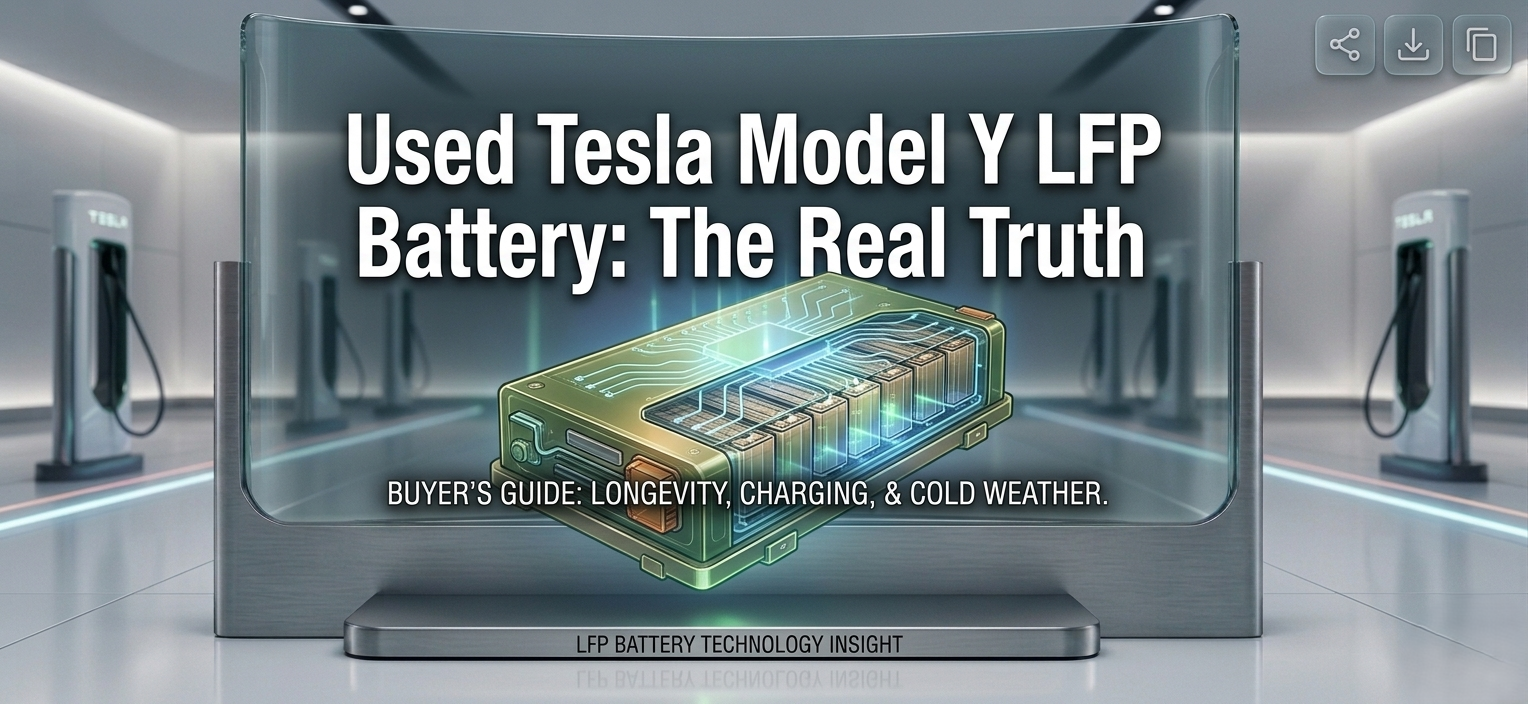
LFP stands for Lithium Iron Phosphate. Tesla started installing LFP batteries in Standard Range Model 3 and Model Y vehicles from 2021 onward, replacing the older NMC (Nickel Manganese Cobalt) chemistry in entry-level trims.

When someone asks “is used Tesla Model Y LFP battery worth buying,” the real answer depends on understanding what makes this chemistry different. LFP batteries are built for longevity, not peak performance. They charge slower at the top end, offer slightly less range, but degrade at a fraction of the rate of NMC batteries. A well-maintained LFP battery in a 2021 Model Y still has approximately 92–95% of its original capacity today.
Two Model Ys can look completely identical on a used car listing same trim, same color, same mileage and have fundamentally different battery behaviors. That is why knowing the chemistry matters more than most buyers realize.
| Spec | LFP Battery |
| Cycle life | 3,000+ full charge cycles (vs ~1,500 for NMC) |
| Capacity after 5 years | Approximately 90–95% retained |
| Safe daily charge limit | 100% Tesla officially recommends it |
| Thermal stability | Lower risk than NMC chemistry |
LFP vs. High-Nickel (NMC/NCA): Which Should You Choose?
This is the comparison that actually determines whether is used Tesla Model Y LFP battery worth buying for your specific situation.

The “100% Charging” Convenience Why It Changes Your Daily Life
This is LFP’s single biggest practical advantage, and it is wildly underreported. With NMC batteries, Tesla recommends staying below 80–90% for daily charging to preserve long-term battery health. That means a car rated at 330 miles effectively gives you 264–297 usable miles on a typical day.With LFP, Tesla explicitly recommends charging to 100% daily. You plug in every night, wake up every morning with a full battery, and never think about charge limits.
For a commuter driving 30–50 miles per day, this eliminates an entire layer of EV ownership anxiety. No math, no scheduling, no guilt about charging habits. Just plug in and go.This “set it and forget it” charging behavior is a core reason why is used Tesla Model Y LFP battery worth buying for pragmatic daily commuters. You can learn more about how Tesla insurance works for EV owners to understand the full cost picture before buying.
| Real-world exampleA 40-mile round-trip commuter with an LFP Model Y plugs in every night to 100%, uses ~15% of the battery, and starts each day fully charged. With an NMC Long Range set to 80%, they have more theoretical range but rarely need it, and pay a premium for it. |
Real-World Cold Weather Performance
Cold weather is where LFP chemistry is genuinely weaker than NMC. Here is what the data actually shows:

| Condition | LFP Range Retained | NMC Range Retained |
| 70°F ideal | 100% | 100% |
| 32°F freezing | 75–80% | 85–88% |
| 14°F very cold | 60–65% | 72–76% |
The practical takeaway: if you live in Minnesota, Montana, or anywhere with sustained sub-freezing winters and no garage, LFP’s winter range loss becomes a daily inconvenience. If you are in Texas, California, or the Southern US, cold weather is nearly irrelevant to your decision.
Is a Used Tesla Model Y LFP Battery Worth Buying for You?
Stop reading generic reviews. Answer these three questions about your actual driving life:

- How far do you drive daily? If your round trip is under 120 miles, is used Tesla Model Y LFP battery worth buying for your needs the range is more than sufficient.
- What climate do you live in? Mild or warm climate? LFP is an excellent fit. Sustained sub-zero winters with no garage? The cold-weather range loss becomes a daily friction point.
- How long do you plan on owning the car? 7–10 years? LFP is the better long-term bet. Flipping in 2–3 years? Market depreciation will be a bigger factor than battery type.
Decision matrix:
| Your situation | LFP verdict |
| 30–60 mi/day commuter, mild climate | Perfect fit |
| Frequent 200+ mi road trips | Workable, but requires Supercharger planning |
| Sub-freezing winters, no garage | Consider NMC Long Range instead |
| Buying to keep 8–10 years | LFP ages significantly better |
| Budget buyer, first EV | Strong choice lower price, minimal battery risk |
| Rideshare driver, 200+ mi/day | Possible, but charging stops add up |
How to Tell If Your Tesla’s Battery Is LFP

Here is the most critical information you need to make the right choice. When you are evaluating a used Model Y listing, you need to verify the battery chemistry yourself do not rely on the seller. Many sellers genuinely do not know what chemistry their car has.
The Software Verification Method (Most Reliable)
This works on any Tesla you can physically access and is 100% accurate.
| 1 | Check Additional Vehicle InformationNavigate to Controls → Software → Additional Vehicle Information. Some model years list the battery type directly here. |
| 2 | Use the Tesla appUnder Schedule → Charge Limit in the Tesla app, LFP vehicles default to 100% as the recommended setting. NMC vehicles default to 80%. |
Understanding Battery Codes (If Buying Remotely)
- Model year 2021–2023, Standard Range trim: almost certainly LFP. Tesla transitioned all SR trims to LFP during this period.
- Long Range and Performance trims: these use NMC/NCA chemistry regardless of year not LFP.
- Third-party tools: services like Recurrent Auto can confirm battery chemistry via VIN for a small fee. Worth it for remote purchases.
- Never rely on the seller’s word alone. Most sellers simply do not know.
The Financial Reality: Depreciation and Battery Health

One of the biggest reasons buyers ask “is used Tesla Model Y LFP battery worth buying” is fear around resale value. Here is what the numbers actually show.
Does LFP Hurt Resale Value?
No and in some cases it helps. LFP batteries degrade so slowly that battery health becomes a selling point, not a liability. A 3-year-old LFP Model Y with 40,000 miles likely has 93–96% of its original capacity. That is measurable, verifiable, and increasingly something informed used EV buyers actively look for.
- LFP batteries degrade significantly slower 92–95% capacity retained after 3 years of typical use.
- Buyers who understand EVs increasingly seek out LFP specifically for long-term ownership.
- The bigger resale variable is overall Tesla market depreciation all Teslas dropped after 2022–2023 price cuts. Battery chemistry is a secondary factor.
What About Battery Replacement Cost?
Tesla Model Y battery replacement costs approximately $10,000–$16,000 out of pocket. However, for LFP vehicles, this is a genuinely rare scenario. The chemistry’s longevity means most LFP batteries will outlive the rest of the car’s component.It is also worth understanding the full ownership cost picture including how insurance premiums are calculated for used Teslas. This guide on Tesla insurance and rental car coverage breaks down what to expect on that front.
What Type of Batteries Do Teslas Use?
Tesla uses three main battery chemistries across its lineup. When people ask “is used Tesla Model Y LFP battery worth buying,” the answer is specifically about the LFP chemistry a fundamentally different ownership experience from NMC vehicles that dominated used Tesla listings before 2021.
- LFP (Lithium Iron Phosphate): Standard Range Model 3 and Model Y from 2021 onward. Slower degradation, 100% daily charging, lower peak range, better long-term durability.
- NMC (Nickel Manganese Cobalt): Long Range and Performance trims. Higher energy density, better cold-weather performance, should stay below 80–90% for daily use.
- NCA (Nickel Cobalt Aluminum): Model S and Model X. Highest energy density, longest range, premium segment only.
One thing buyers sometimes wonder: does Tesla make hybrid vehicles? No Tesla has never produced a hybrid. The company went all-electric from day one. If you are curious about why Tesla skipped hybrids entirely, that breakdown explains Tesla’s all-electric philosophy from the beginning.
Frequently Asked Questions About Tesla LFP Batteries
Is used Tesla Model Y LFP battery worth buying for long commutes?
For commutes under 120 miles round trip, yes absolutely. The Standard Range LFP Model Y has an EPA rating of approximately 260 miles, which comfortably handles most daily driving with charge to spare. For commutes over 150 miles round trip, the Long Range NMC version gives you more buffer.
Can I charge my LFP Model Y to 100% every day?
Yes Tesla explicitly recommends it for LFP vehicles. This is not just permitted; it is the intended use case. Regular full charges also help the battery management system accurately calibrate the state-of-charge meter, keeping your range estimates accurate over time.
Will my LFP battery die in winter?
No but it will lose range temporarily in very cold weather. Expect 20–35% less range below freezing. Pre-conditioning the battery while still plugged in (via the Tesla app) before you drive recovers most of this loss. The battery itself is not damaged by cold; it simply performs less efficiently at low temperatures.
How much does it cost to replace a Tesla Model Y battery?
Approximately $10,000–$16,000 for out-of-pocket replacement. Tesla’s 8-year / 100,000-mile warranty covers defects and capacity loss below 70%. For LFP vehicles, replacement within the first 10 years of normal use is genuinely uncommon.
Is used Tesla Model Y LFP battery worth buying vs. waiting for a new one?
In most cases, a used LFP Model Y offers significantly better value per dollar than buying new, because the battery chemistry means you are not inheriting a degraded battery you are getting a car whose battery will perform nearly identically to new for years to come.
Bottom Line: Is a Used Tesla Model Y LFP Battery Worth Buying?

For the pragmatic daily commuter who drives 30–60 miles per day, lives in a moderate climate, and wants to own a car for the long haul yes, is used Tesla Model Y LFP battery worth buying, and it may be the smartest used EV purchase available right now.
You get a battery that barely degrades, the freedom to charge to 100% every night, a lower purchase price than the Long Range, and long-term durability that outlasts most of the car’s other components.
The only buyers who should look elsewhere are those facing sustained extreme cold with no garage, or those who regularly need 200+ miles per charge on long highway trips. For everyone else, the LFP Model Y is not a compromise it is the right tool for the job.